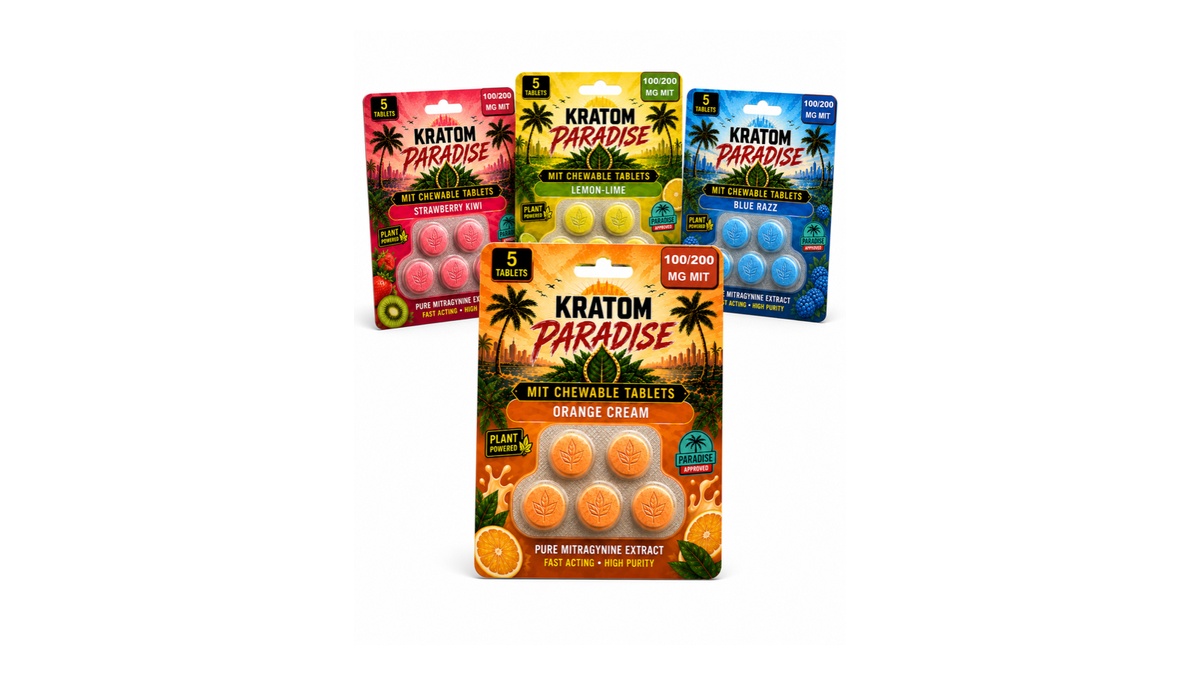
The Rise of MIT Tablets: Why Mitragynine Chewable Tablets Are Becoming a Major Kratom Format in 2026
MIT tablets have become a prominent kratom format because they place mitragynine—the principal psychoactive alkaloid usually measured in kratom leaf—into a compact, flavored, countable product. For shoppers comparing loose powder, capsules, gummies, liquid extract shots, and the shrinking 7-OH market, tablets offer a simpler physical format without pretending that mitragynine is inactive.
People consume mitragynine products for psychoactive effects that may feel alerting, relaxing, or pain-relieving. Mitragynine acts at human opioid receptors and is partly metabolized to 7-hydroxymitragynine. Concentrated MIT products can also cause unwanted effects and dependence. The case for tablets is therefore practical—clear product identity, portability, storage, and countable units—not a promise of safety or one guaranteed experience.
What are MIT tablets?
MIT is shorthand for mitragynine. An MIT tablet is a formulated tablet built around a labeled mitragynine product identity rather than a traditional leaf-powder strain name. It should be distinguished from a capsule filled with ordinary kratom leaf, a gummy or liquid shot with its own ingredient system, and a product centered on enriched or synthetic 7-OH.
Kratom Paradise organizes its current MIT chewable tablets by three visible fields: a labeled 100mg or 200mg MIT option, flavor, and tablet count. Those fields belong together, but they should not be expanded into an unstated analytical claim. The current verified label does not provide a basis for inventing a per-tablet assay from the selector alone.
Why tablets are gaining ground over gummies and liquid shots
Gummies and liquid extract shots made concentrated kratom easy to recognize as a convenience product. They also introduced form-specific tradeoffs. Gummies use a confection matrix and can become sticky or soften in heat. Shots require a bottle, liquid-volume labeling, leak management, and often a longer ingredient panel. Loose extract powder is lightweight and flexible, but it requires careful handling and a dry measuring routine.
Tablets avoid several of those problems at once. They are dry, compact, countable, and easy to keep in the original labeled package. A buyer can select a flavor and count without managing loose powder or a small liquid bottle. Those advantages explain why someone searching for kratom gummies, liquid extract shots, or portable extract products may ultimately prefer a tablet.
| Format | What defines it | Practical tradeoff |
|---|---|---|
| Leaf capsule | Dried leaf inside a capsule shell | Countable, but not the same composition as a concentrated MIT tablet |
| Gummy or soft chew | Concentrated alkaloids in a confection matrix | Familiar form, with sweeteners and heat or texture concerns |
| Liquid extract shot | Concentrated liquid in a small bottle | Portable, but adds fluid-volume math, leakage risk, and liquid ingredients |
| MIT tablet | Mitragynine-centered formulated tablet | Dry, flavored, compact, and countable |
| MIT extract powder | Concentrated dry material sold by net weight | Flexible package sizes, with more handling than tablets |
The Kratom Extract Types & Formats Guide compares these categories in more detail. Physical form can change convenience and labeling, but it does not determine how strong a product will feel.
MIT tablets are not leaf capsules
Ordinary kratom capsules usually contain milled Mitragyna speciosa leaf and are described by capsule count and, where disclosed, fill weight. MIT tablets are formulated, concentrated products organized around a mitragynine label. A 500mg leaf-capsule fill and a 100mg MIT selector are therefore different kinds of information and should not be compared as though the numbers share one material basis.
This distinction matters for both shopping and search. “Kratom tablets,” “mitragynine tablets,” and “MIT chewables” often refer to concentrated formulated products, while “kratom capsules” generally refers to encapsulated leaf. The ingredient statement and complete label settle the category better than the shape of the unit.
Why MIT belongs in a different lane from 7-OH and Oxonol
Mitragynine and 7-OH are related but not interchangeable. Mitragynine is naturally present in kratom leaf and produces weaker mu-opioid-receptor activation than 7-OH. Commercial enriched 7-OH products can deliver concentrations far above the trace levels associated with ordinary leaf and have been linked to rapidly increasing tolerance, dependence, and difficult withdrawal in some consumers.
Oxonol is a commercial name whose manufacturer has described a formula containing MGM-15 and mitragynine. MGM-15 is a synthetic 7-OH derivative named in a separate July 2026 DEA notice of intent. Calling every product a kratom tablet would obscure the most important fact: MIT, enriched 7-OH, and MGM-15 are different active compound identities.
For the current comparison, read 7-OH vs Kratom vs MIT and the DEA 7-OH scheduling tracker. Kratom Paradise does not sell synthetic or enriched 7-OH products.
How the current Kratom Paradise tablet line is organized
The standard tablet listing currently offers labeled 100mg and 200mg MIT options, Orange Cream, Strawberry Kiwi, Lemon-Lime, and Blue Razz flavors, and packages of 5, 10, 25, or 50 tablets. The bulk MIT tablet listing uses the same labeled options and flavors with counts of 100, 500, 1,000, or 5,000 tablets.
Standard and bulk are quantity lanes, not different alkaloids. The exact product title, labeled MIT option, flavor, and tablet count should remain visible in the cart, order record, and stored package. Bulk also does not automatically include reseller, private-label, territory, or reserved-inventory rights.
How the 90% MIT-CH COA relates to the tablets
Kratom Paradise has confirmed that the tablet line is made from the 90% MIT-CH source concentrate associated with laboratory sample 141690. The referenced report identifies that submitted source material and reports its analytical results, including 7-OH as ND under the method and limits shown on the document.
That is a meaningful product-document relationship: it identifies and characterizes the concentrate used to make the tablets. It is not the same as testing a finished tablet. The report should therefore be described as a source-material COA, not a finished-tablet assay or proof that every flavor, packaged unit, or future lot was independently analyzed under that report.
The MIT Product Documents & COA Center keeps the current report link and scope explanation in one place. The source relationship should also remain visible on both the standard and bulk tablet pages.
How to compare MIT tablets without confusing the label
- Confirm that the product is an MIT tablet rather than a leaf capsule, gummy, liquid shot, extract powder, 7-OH product, or MGM derivative.
- Read the labeled MIT option exactly as shown; do not add a per-tablet analytical basis the verified label does not state.
- Select flavor and tablet count as separate fields.
- Keep standard and bulk quantity lanes separate.
- Open the source-material report and retain its sample identity, units, method, and limits.
- Verify current price, availability, and destination eligibility on the live listing.
Frequently asked questions
Are MIT tablets psychoactive?
Yes. Mitragynine is a psychoactive kratom alkaloid that acts at human opioid receptors. A tablet format does not make it inactive or guarantee one effect.
Are MIT tablets the same as kratom capsules?
No. Standard kratom capsules generally contain dried leaf powder. MIT tablets are formulated products centered on concentrated mitragynine.
What do the 100mg and 200mg choices mean?
They are the labeled MIT options on the current listings. Flavor and tablet count are separate selectors. Kratom Paradise does not infer a per-tablet analytical result beyond what the verified label expressly states.
Does the 90% MIT-CH COA apply to the tablet line?
It applies as documentation for the source concentrate used to make the tablets. It is not represented as a finished-tablet COA.
Are MIT tablets the same as 7-OH or Oxonol?
No. MIT refers to mitragynine. Enriched 7-OH is a different alkaloid exposure, and Oxonol is a commercial product name associated with a formula described as containing MGM-15 plus mitragynine.
Why choose tablets over gummies, shots, or powder?
Tablets are dry, compact, flavored, and countable. They avoid loose-powder handling, liquid leakage, and a gummy confection matrix. Those are form-factor advantages, not guaranteed-effect claims.
Sources and further reading
- Human opioid-receptor pharmacology of mitragynine and 7-OH
- Human mitragynine and 7-OH pharmacokinetics after oral kratom leaf
- FDA: Hiding in Plain Sight—7-OH Products
- DEA: July 2026 announcement concerning 7-OH and related substances
- MIT Products Guide
Adult product-format and document education only. No medical, serving, conversion, or legal advice is provided.