
Kratom Before Ecommerce: Southeast Asian History, Culture, and the Early Written Record
Prepared and maintained by the Kratom Paradise Editorial Team. Last editorial review: July 13, 2026. Read our editorial standards and sourcing policy.
Long before kratom appeared in pouches, capsules, laboratories, or online catalogs, it was a living tree in the wet tropical landscapes of Southeast Asia. Its history begins with place: village gardens, river systems, forest margins, farms, and the everyday knowledge of people who recognized the leaf generations before Western botany assigned it a Latin name.
That older history is not a single straight timeline. It is a combination of local names, oral knowledge, traditional preparation, colonial-era botanical records, modern ethnographic research, changing Thai law, and twenty-first-century plant science. Together, those records show how a regional tree became an internationally recognized botanical without losing its connection to Southeast Asia.
A tropical tree with a wide native range
Kew Science accepts Mitragyna speciosa as a species in the coffee family, Rubiaceae. Its recorded native range stretches from southern Indochina through Borneo, Malaya, Myanmar, Sumatra, Thailand, Vietnam, the Philippines, and New Guinea. Kew describes it as a tree of the wet tropical biome. That distribution is larger and more ecologically varied than any one modern product name suggests.
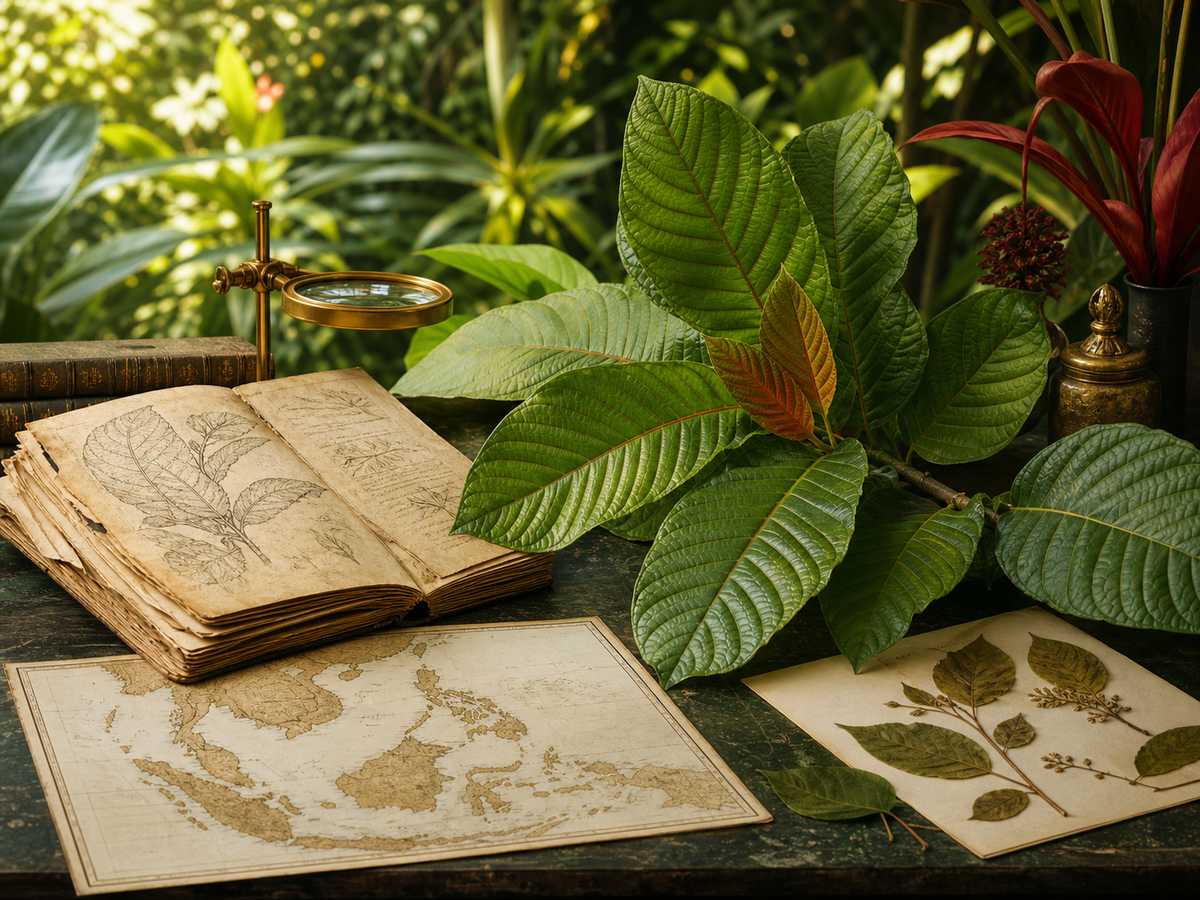
The tree is recognized by broad, glossy leaves with strong lateral veins and by rounded flower heads typical of the genus. Modern genomic research has added another layer to the botanical portrait. A chromosome-scale genome published in 2022 assembled the species into 22 pseudomolecules and examined genetic diversity among 85 Thai accessions. The work found evidence of two admixed subpopulations, a reminder that kratom is a biologically variable plant rather than a uniform manufactured ingredient.
Botanical identity matters because regional trade names and color families developed much later than the tree itself. Red, green, white, Bali, Thai, Malay, Borneo, Vietnam, and Maeng Da are familiar parts of the modern marketplace. They help people navigate products, but they should not be mistaken for a complete botanical map or a guarantee that every pouch came from the place named on its front.
A distant relative of coffee
Rubiaceae is often called the coffee family, but a shared family does not make kratom a kind of coffee. Botanical families are broad branches built from inherited structural and genetic relationships. Their members can develop very different leaves, fruits, chemistry, and human uses over long periods of evolution.
The 2022 chromosome-scale genome study compared Mitragyna speciosa with Coffea arabica and Coffea canephora and estimated that their lineages separated from a common ancestor roughly 47.6 million years ago. The comparison helps researchers place the species on the flowering-plant tree of life. It also gives useful scale: kratom's identity is ancient in an evolutionary sense even though its modern international product category is recent.
Before written botany: local knowledge and a quiet record
Plants used as leaves rarely leave the same archaeological trail as ceramics, metal tools, buildings, or preserved grain. The research and botanical records cited here do not establish a securely dated archaeological specimen proving ancient kratom use. The earlier record instead survives through local practice, language, traditional texts, and knowledge passed within communities.
In Thailand, the word krathom became the best-known regional name. In Malaysia, ketum is common. Local terminology matters because it shows that the plant was not born as a Western retail category. It belonged first to the languages and routines of the places where it grew. Fresh leaves could be handled soon after harvest, and water-based preparations could be made without the milling, encapsulation, standardized packaging, or long-distance storage required by international commerce.
Modern studies in southern Thailand have documented how community knowledge persisted. One mixed-method study reviewed six Thai traditional medical scriptures and interviewed or held focus groups with 39 folk healers. The researchers found written formulas as well as practices transmitted through families and teachers. Leaves were the plant part most frequently recorded, and decoction was the most commonly documented preparation. Those findings describe a historical knowledge system; they are not product directions or claims about outcomes.
The first formal botanical publication
The nineteenth century brought kratom into European botanical classification. Kew's current taxonomic record lists the accepted name Mitragyna speciosa Korth. and dates its first formal publication to 1841. The species later appeared under names including Stephegyne speciosa and Nauclea speciosa before the accepted classification settled into modern use.
That sequence explains why different years sometimes appear in retellings of kratom history. Pieter Willem Korthals worked on the genus in the late 1830s, while the accepted species record cited by Kew points to the illustrated 1841 publication. Botanical naming is a chain of descriptions, combinations, and revisions, not a single moment when local people suddenly discovered a plant they already knew.
The name Mitragyna refers to the mitre-like form associated with the flower's reproductive structures. Speciosa is a Latin epithet meaning showy or splendid. The scientific name gave researchers a common reference, while regional names continued to carry the plant's cultural identity. Both systems remain visible today: one in laboratory and regulatory documents, the other in conversation and commerce.
From household plant to controlled crop
During the twentieth century, Thai policy placed kratom under long periods of control. That legal history changed cultivation, trade, and the visibility of community practice, but it did not erase the plant from southern Thai life. Researchers continued to encounter established trees, household knowledge, and local patterns of preparation.
Thailand's legal direction changed decisively in the early 2020s. The Kratom Plant Act B.E. 2565, published in 2022, defines the kratom plant by the scientific name Mitragyna speciosa. The Act addresses import and export licensing, sales protections, research, processing, cultivation, and the development of kratom as a plant with economic value. It also directs public agencies to support knowledge and technology related to cultivation and processing while establishing age and marketing safeguards.
The change was more than a commercial event. It allowed a familiar regional plant to be discussed openly as agriculture, community knowledge, research material, and regulated commerce. Modern Thai studies can now map genetic diversity, growing conditions, seasonal variation, and postharvest handling with a visibility that would have been difficult under the older legal framework.
How a fresh leaf became an international powder
Fresh leaves make sense near the tree. International distribution requires a more stable format. Drying removes much of the leaf's moisture, milling reduces the dried material to powder, and packaging protects the result during transport and storage. Capsules place that powder into measured shells. Extract products use additional processing and should be labeled as a different format rather than blended into the identity of ordinary leaf powder.
This transition changed the vocabulary around kratom. A village household might distinguish trees by location, appearance, or family history. A modern customer encounters pouch weight, capsule count, batch identity, ingredient statements, laboratory reports, and familiar market names. The tree is the same species, but the information needed to move it through a global supply chain is very different.
Kratom Paradise keeps that distinction visible. Botanical powder and leaf-filled capsules remain separate from MIT-labeled formats and from synthetic 7-OH products. Readers who want a closer look at those modern categories can continue with the Kratom Product Types guide and the 2016 to 2026 Kratom Timeline.
A short evidence-based timeline
- Before formal botany: Local names, oral knowledge, household cultivation, and traditional written formulas preserve the regional record.
- 1841: Kew dates the first formal publication of Mitragyna speciosa to an illustrated botanical work from the Dutch East Indies.
- Twentieth century: Thai controls reshape cultivation and public visibility while community knowledge persists.
- 2010s: Ethnographic and traditional-knowledge research documents practices in southern Thailand.
- 2022: Thailand's Kratom Plant Act establishes a modern legal framework for cultivation, research, processing, trade, and safeguards.
- 2020s: Genome, geography, season, and postharvest studies describe the plant with new precision.
What the history leaves us
Kratom's story is neither a newly invented supplement trend nor a frozen ancient ritual. It is a living botanical history. Local practice came first. Scientific naming created a shared reference. Regulation interrupted and redirected the public record. Modern research is now revealing the genetic and environmental complexity of the tree, while global commerce has turned fresh regional leaves into shelf-stable formats.
The most respectful way to read that history is to keep its layers intact. Southeast Asian communities are not a decorative origin story. Botanical names do not replace local names. Familiar retail labels are not proof of exact geography. Laboratory detail does not erase culture. Each layer answers a different question about how Mitragyna speciosa moved from tropical landscapes into the modern world.
Sources and further reading
- Royal Botanic Gardens, Kew: Mitragyna speciosa
- A chromosome-scale genome and genetic-diversity assessment of Mitragyna speciosa
- Traditional use among folk healers in southern Thailand
- Thailand Office of the Council of State: Kratom Plant Act B.E. 2565
This material is provided for botanical, historical, and cultural education. It is not medical or legal advice.