
Kratom & kava guides
From Leaf to Powder: How Kratom Is Harvested, Dried, Milled, and Prepared
Written and maintained by the Kratom Paradise Editorial Team. Read our editorial standards and sourcing policy.
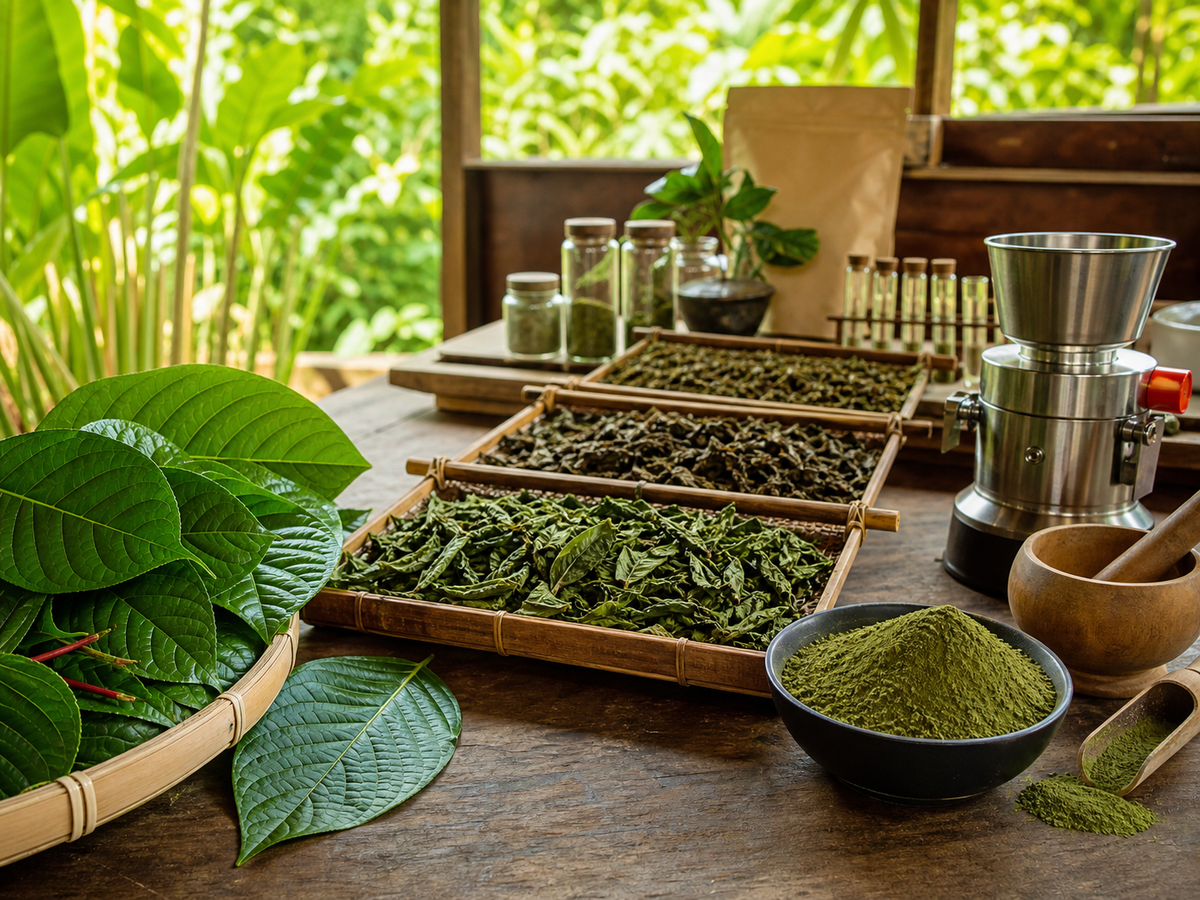
A pouch of kratom powder begins as a living leaf. Between the tree and the finished package, the material passes through harvest, sorting, moisture loss, drying, milling, screening, blending, sampling, testing, and packaging. Each stage affects more than appearance: it shapes the material’s chemistry, consistency, and contaminant controls.
The process is easy to oversimplify. Powder is not merely a fresh leaf placed in a grinder. Fresh plant material contains substantial moisture and does not store or mill like a dry botanical. Drying conditions influence color and chemistry. Particle size affects how powder moves and mixes. The sample sent to a laboratory must represent the larger lot. Packaging must then limit exposure to humidity, light, and air.
Stage one: harvest begins with biological variation
Mitragyna speciosa is a tropical tree with natural variation among regions, seasons, and individual trees. Kew records a native range extending across much of Southeast Asia and into New Guinea. Trees grow under different combinations of rainfall, soil, humidity, sunlight, age, genetics, and seasonal timing. Those differences mean that two baskets of leaves can begin with different physical and chemical profiles even before postharvest work starts.
For the living tree's accepted name, morphology, range, and habitat, read Mitragyna speciosa: A Botanical Guide to the Kratom Tree.
A 2022 field study of naturally growing Thai kratom analyzed leaves from multiple regions and reported measurable variation associated with environmental conditions such as light, relative humidity, soil moisture, pH, and calcium. A separate 2023 investigation examined hundreds of Thai samples across geography and season and found that mitragynine, paynantheine, and speciogynine levels varied. The researchers also reported that leaf-vein color did not reliably explain those geographical differences.
Leaf color alone cannot describe a kratom lot's alkaloid profile. Red, green, white, and yellow are familiar market families, but batch records and laboratory testing provide information that color does not.
Stage two: sorting and handling fresh leaves
After harvest, leaves are commonly sorted to remove unrelated plant matter and material that does not belong in the lot. Clean handling also makes the next stage more even. Leaves piled too deeply, left wet, or dried at very different rates will not move through the process uniformly. Airflow, surface area, time, and temperature all matter.
Research experiments often standardize leaf position and maturity to make treatment comparisons meaningful. In a 2025 postharvest study, researchers selected mature leaves from the second or third pair below the growing tip, mixed the harvest, divided it into treatment groups, and controlled withering and drying conditions. That experimental method is not a claim that every commercial producer follows one identical harvest rule. It demonstrates why traceable handling is necessary when researchers want to compare results.
Stage three: withering begins moisture loss
Withering is the early loss of moisture after a leaf is removed from the tree. The leaf softens, its mass changes, and internal plant processes continue for a period after harvest. In tea production, withering is a recognized stage. Kratom research is now examining it directly rather than treating all pre-drying time as an invisible gap.
The 2025 Frontiers study compared leaves with no planned withering against 12-, 24-, and 72-hour treatments before drying. The results showed that withering, season, genotype, and drying temperature interacted rather than producing one universal rule. That is important: postharvest labels such as sun dried, indoor dried, or fermented are not complete technical descriptions unless time, temperature, airflow, leaf depth, and sampling are also understood.
Stage four: drying creates a stable botanical material
Drying removes enough moisture for the leaf to become brittle, millable, and more suitable for storage. Producers may use ambient air, fans, controlled hot air, shade, sunlight, or specialized equipment. Each method creates a different combination of temperature, airflow, light exposure, duration, and final moisture.
Controlled studies show why the details matter. The 2025 Frontiers experiment compared drying at 25, 40, 60, and 80 degrees Celsius, with freeze-drying added for part of the work. Researchers observed greener powders at lower temperatures and more reddish-brown color under higher-temperature conditions. They also found that postharvest treatment affected measured alkaloid concentrations, with results differing by genotype and season.
Another 2025 study compared freeze-drying with convective hot-air drying. In that experiment, freeze-drying and 40-degree Celsius hot-air drying retained the highest measured mitragynine values among the tested treatments, while higher temperatures reduced the measured amount. Freeze-drying also produced leaf color closer to the fresh material. These findings belong to defined experimental conditions; they do not turn a particular shade of powder into a universal strength code.
Stage five: milling and screening determine the powder
Once properly dried, leaves can be reduced to coarse pieces and then milled into fine powder. Milling is a physical size-reduction step. It does not convert ordinary leaf into an extract, and it does not create mitragynine that was absent from the plant. The objective is a usable, reasonably uniform particle size.
A screen or sieve can separate oversized fibers and help make texture more consistent. Fine powder flows, settles, and disperses differently from crushed leaf. Equipment also needs to be managed so one batch is not casually mixed into the next. Batch identity should follow the material from receiving through packaging rather than being added as an afterthought.
The distinction between powder and extract is straightforward. Leaf powder contains milled botanical material. An extract uses additional processing to concentrate selected constituents and must carry different concentration, strength, and serving information. Plain kratom leaf and MIT extract powder differ sharply in strength, taste, and handling.
Stage six: blending can improve lot consistency
A harvested lot may contain natural variation from tree to tree or leaf to leaf. Controlled blending can distribute that variation more evenly within a finished batch. The goal is not to hide the material's identity. It is to prevent the top of a lot and the bottom of a lot from behaving like unrelated products.
Meaningful blending depends on records. A batch identifier should connect the finished package to the source lots and the sample tested. Without that chain, even an impressive-looking laboratory report becomes difficult to match to the material in front of the customer.
Stage seven: sampling and laboratory reports
A laboratory analyzes the sample it receives, not every particle in every pouch. Representative sampling is therefore part of quality control. A small scoop taken from one convenient corner may not describe a large lot as well as a planned composite sample taken from multiple locations.
The resulting certificate of analysis should identify the laboratory, sample or batch, methods, dates, reported units, and results. Depending on the testing program, a report may include identity or alkaloid measurements and quality panels such as microbial or elemental testing. Readers can use the Kratom COA guide to examine those sections in more detail.
A single percentage should not be detached from its units and sample identity. Results measured as percent by weight, milligrams per gram, or another unit are not interchangeable without conversion. Leaf powder results also should not be compared casually with the label of a concentrated MIT product. Format comes first.
Stage eight: packaging protects the finished powder
After milling and testing, packaging becomes the final physical barrier between the powder and its environment. A properly closed pouch helps limit humidity, light, air exchange, odors, and ordinary handling. The label carries the information needed after the bulk lot has been divided: product name, net weight, batch reference where available, ingredient statement, and storage guidance.
Once opened, the same principles still apply. Keep the package closed between uses, use dry utensils, and store it in a cool, dry place away from prolonged direct light. More detailed handling information appears in the Kratom Storage guide.
What powder color can and cannot tell you
Powder color is visible, memorable, and useful for identifying a product family. It can also reflect leaf condition, drying temperature, light exposure, withering, particle size, and blending. That makes color an observation, not a complete laboratory result.
The postharvest research is especially clear on this point. Changing treatment conditions changed powder appearance, but chemistry also depended on genotype and season. Two powders that look similar may not be identical, and two powders with different shades are not automatically opposites. Color alone cannot identify the product, lot, ingredients, or lab results.
A practical checklist for comparing leaf powders
- Confirm that the ingredient is identified as Mitragyna speciosa leaf powder.
- Read the net weight and distinguish leaf powder from extract powder.
- Look for a batch or sample connection when laboratory documentation is provided.
- Read reported units before comparing laboratory values.
- Treat color and regional names as product identifiers, not complete chemical specifications.
- Keep the pouch sealed and dry after opening.
Fresh kratom leaf changes during drying, milling, sampling, testing, and packaging. Drying can alter color and chemistry. Milling makes a fine powder but does not create an extract. Testing applies to the laboratory’s sample, and sealed packaging protects the finished powder from humidity, light, and air. Records connect those steps to the final lot.
Compare Kratom Powder with capsules and MIT formats in the Product Types guide.
Sources and further reading
- Royal Botanic Gardens, Kew: Mitragyna speciosa
- Environmental variation in naturally growing Thai kratom
- Seasonal and geographic alkaloid variation in Thailand
- Postharvest, genetic, and seasonal factors in kratom
- Hot-air and freeze-drying comparison
This material is provided for botanical and product-format education. It is not medical advice.
Continue with Kratom Supply Chain from Farm to Shelf for the records connecting these stages, or Indonesia’s Kratom Economy for the people and businesses behind them.