
Mitragyna speciosa: A Botanical Guide to the Kratom Tree
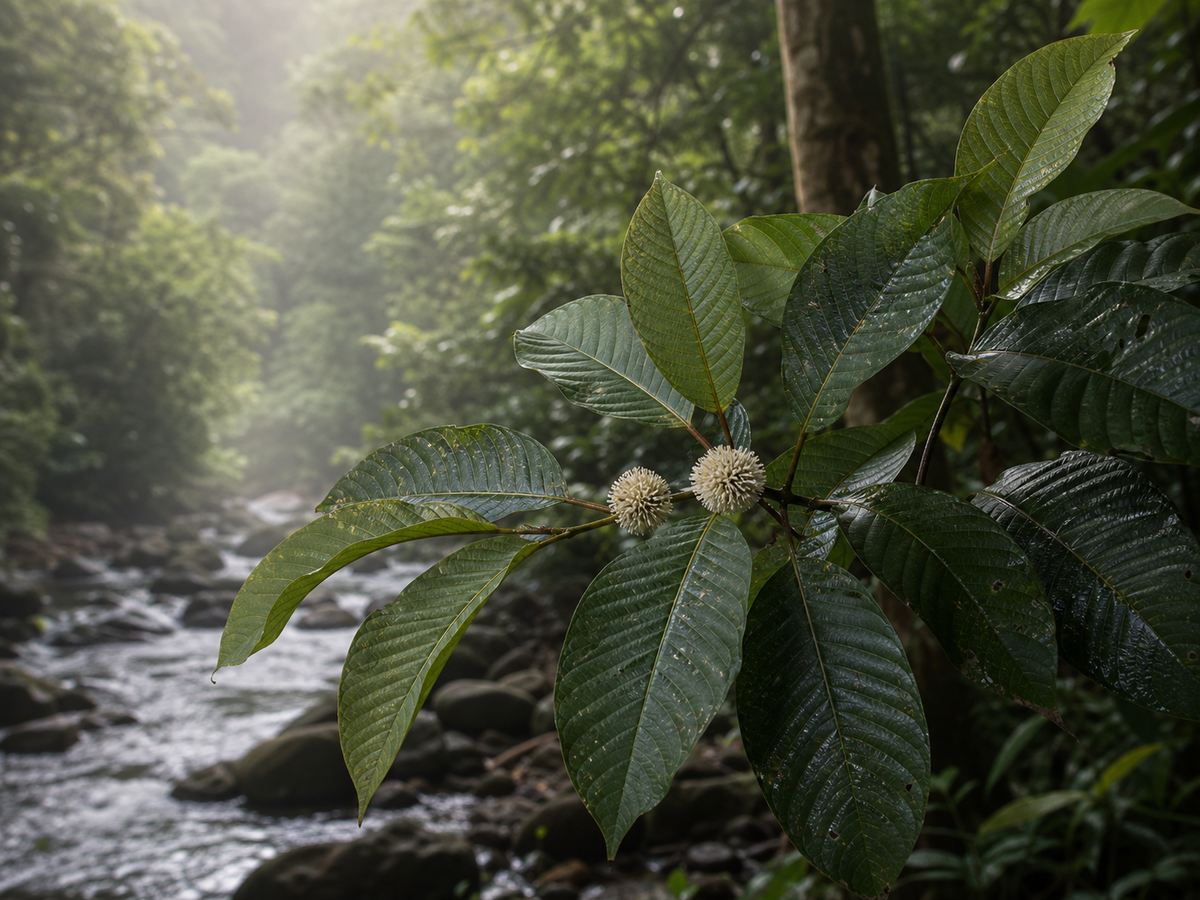
Before kratom is dried, milled, placed in capsules, or made into an extract, it is a tree: Mitragyna speciosa. That scientific name anchors the subject to one botanical species. It separates the identity of the plant from product formats, color labels, and geography-style catalog names.
Botanical identity begins with features that can be observed and documented: the arrangement of the leaves, the stipules between their stalks, the rounded flower heads, the fruit, the seeds, and the structure of the tree itself. Range and habitat add another layer, but neither a place name nor a leaf color can replace those features.
Mitragyna speciosa is the accepted botanical name
Royal Botanic Gardens, Kew currently accepts Mitragyna speciosa in the family Rubiaceae. World Flora Online uses the same accepted species name. Historical botanical literature also records names in the genera Nauclea and Stephegyne, reflecting earlier classification work rather than different products.
The word after the genus is the specific epithet: speciosa. Together, the two words identify the species. The author abbreviation that sometimes follows the name records nomenclatural history; it is not part of the everyday product name. A label that identifies plain leaf powder as Mitragyna speciosa is therefore making a species-level statement.
Where the kratom tree sits in plant classification
Plant classification is a nested system. Each rank places the species inside a progressively broader group. For kratom, the most useful part of that sequence is:
- Order: Gentianales
- Family: Rubiaceae
- Genus: Mitragyna
- Species: Mitragyna speciosa
The genus Mitragyna contains multiple species. Kratom refers specifically to M. speciosa in the Kratom Paradise catalog. A plant can share the same genus or family without being the same species, carrying the same chemistry, or belonging in the same finished product.
Meet the accepted relatives and the evidence used to separate them in Kratom's Relatives: Understanding the Mitragyna Genus.
What it means to belong to the coffee family
Rubiaceae is often called the coffee family because it includes the genus Coffea. Mitragyna and Coffea are separate genera within that much larger family. Their relationship is real, but broad—similar to two branches on a large family tree rather than two names for the same plant.
Kew describes common Rubiaceae features such as simple leaves that are often opposite, stipules between the leaf stalks, tubular flowers, and an ovary positioned below the other flower parts. Those shared structural patterns help botanists recognize relationships. They do not mean that a kratom leaf is a coffee leaf or that the two plants should be compared by taste, caffeine content, product format, or expected outcome.
A kratom tree at full scale
A 2022 taxonomic treatment based on Thai field surveys and herbarium specimens describes M. speciosa as a briefly deciduous or evergreen tree. Examined trees ranged from 5 to 33 meters tall, and mature trunks could be substantial. Some trees develop buttresses at the base. The bark may be smooth or scaly and grey to greyish brown.
That description matters because commercial material rarely shows the whole organism. Powder presents the leaf after drying and milling. Capsules hold that milled botanical material inside a shell. Extracts involve additional processing. None of those finished formats displays the bark, branching pattern, stipules, flowers, fruit, or full leaf arrangement used in botanical study.
Leaves: opposite pairs, visible veins, and natural variation
Kratom leaves are simple rather than divided into separate leaflets. They occur in opposite pairs, and successive pairs are arranged at right angles along the stem—a pattern botanists call decussate. The 2022 Thai revision reported leaves from about 9 to 24 centimeters long and 3.5 to 12.5 centimeters wide among the specimens examined. Shapes included elliptic, narrowly elliptic, elliptic-oblong, ovate, and occasionally obovate forms.
The upper surface is generally dark green, while the underside is paler. Secondary veins curve away from the midrib and form loops near the margin. Between paired leaf stalks sits an interpetiolar stipule, another useful Rubiaceae feature. These details are far more informative for botanical description than a single color word printed on a pouch.
Red, reddish-green, and pale-green midribs and petioles have all been documented. Importantly, the Thai field researchers observed red and green vein colors on the same plant and reported that young reddish tissue could turn green as it matured. They treated those differences as variation within the species, not proof of separate botanical varieties.
For a closer explanation of how red, green, white, yellow, regional, and Maeng Da names work in a retail catalog, read Why Kratom Strain Names Are Catalog Families.
Flowers, fruit, and seeds
Mitragyna speciosa produces rounded heads made from many small flowers rather than one large flower. The Thai taxonomic treatment described flowering heads about 3 to 4 centimeters across. Individual fragrant flowers had creamy-white to pale-yellow corollas that became darker yellow to orangish yellow with age.
After flowering, the tree develops rounded fruiting heads. The individual fruits change from green to brown or nearly black as they dry and contain numerous narrow, flattened seeds with wings at both ends. Flowers, fruit, and seeds are especially valuable when taxonomists need to distinguish related species; a detached commercial leaf or finished powder provides fewer visible characters.
Follow the complete flower-to-seed cycle and the contrast with stem cuttings in How Kratom Trees Reproduce.
Native range: southern Indochina to New Guinea
Kew records the native range of M. speciosa from southern Indochina to New Guinea. Its country and island records include Cambodia, Myanmar, Thailand, Vietnam, Malaya, Borneo, Sumatra, the Philippines, and New Guinea. A native-range record describes where a species occurs naturally according to the underlying botanical data. It is not the same thing as every place where a tree may be cultivated or every geographic word used in commerce.
The range is broad enough to cross national borders, islands, river systems, and local naming traditions. That is one reason a package name such as Borneo, Malay, Thai, Bali, or Vietnam should not be treated as a complete scientific origin record. Bali, for example, may appear in a catalog family name, but Kew's current native distribution record for the species identifies other Indonesian regions such as Sumatra and Borneo.
Habitat: wet tropical lowlands, streams, and river banks
Kew places the species primarily in the wet tropical biome. The Thai revision gives a more detailed regional picture: tropical lowland evergreen rain forest, often in wet places along streams and river banks, with reports from lowland forest near streams and swamps in Peninsular Malaysia. In the Thai material discussed by the authors, natural habitat records were near sea level to about 200 meters.
Those observations describe documented habitat, not a universal cultivation formula. A greenhouse experiment can isolate light, nutrients, temperature, or water under controlled conditions, but its results do not automatically describe every forest population. Likewise, seeing a cultivated tree outside the accepted native range does not expand the native range by itself. Native, introduced, cultivated, and commercial origin are different categories.
What geography and leaf color cannot establish
A botanical name, a catalog name, and a supply-chain record answer different questions. Mitragyna speciosa identifies the species. A retail family name helps organize products. A documented origin record connects material to a place and source. None can safely stand in for the others.
- A regional-style name does not prove that the material was harvested in that place.
- A red or green midrib does not establish a separate species or guaranteed chemistry.
- Membership in Rubiaceae does not make kratom and coffee interchangeable.
- A photograph can support identification, but a finished powder no longer shows every feature used in a taxonomic key.
- A laboratory result describes the submitted sample and method; it does not replace the source identity and batch connection.
From a living leaf to a labeled botanical product
Species identity is the beginning of the product record, not the end. Once leaves are harvested, later steps can include sorting, withering, drying, milling, blending, sampling, laboratory analysis, and packaging. Each stage changes what can be observed and which records become important.
The complete physical sequence appears in From Leaf to Powder. Readers comparing finished formats can also use the Kratom Product Types guide.
A concise botanical checklist
When a botanical description of kratom appears in a book, database, laboratory document, or product record, these questions help keep the information in scope:
- Does it identify the species as Mitragyna speciosa?
- Is the source describing a living tree, a detached leaf, dried powder, or an extract?
- Does a geographic statement refer to native range, a collection site, cultivation, or a catalog name?
- Are leaf color and shape presented as variable plant features rather than guaranteed product outcomes?
- Does the source separate observed morphology from chemistry measured by a defined laboratory method?
Kratom becomes easier to understand when the tree remains visible in the story. The accepted species name provides the anchor. Leaves, stipules, flowers, fruit, and seeds supply the physical evidence. Range and habitat describe where the species occurs. Processing and documentation then explain how living plant material becomes a finished, labeled product.
Explore the current Kratom Powder guide or view the Kratom Powder collection.
Sources and further reading
- Royal Botanic Gardens, Kew: Mitragyna speciosa
- Kew: Rubiaceae family description
- Kew: Coffea classification
- Ngernsaengsaruay et al. (2022): Thai Mitragyna revision
- World Flora Online: Mitragyna speciosa
- Ridsdale (1978): Revision of Mitragyna and Uncaria
This material is provided for botanical and product-format education. It is not medical advice.
Once whole leaves become powder or extract, laboratories can compare morphology, chemical fingerprints, and DNA within the limits of the material. Read How Kratom Botanical Identity Is Tested.