
Kratom's Relatives: Understanding the Mitragyna Genus
Mitragyna speciosa is one species inside a larger botanical genus. Its relatives share ancestry and a set of structural patterns, but they are not alternate names for kratom. The genus also reaches much farther than the native range of M. speciosa, connecting tropical Asian and African trees within one taxonomic group.
Understanding that hierarchy helps avoid a common identity error. “Mitragyna” identifies a genus. “Mitragyna speciosa” identifies a species. A package, specimen, or laboratory record that stops at the genus has not yet established the species.
A genus is one rank in a nested classification
Botanical classification places organisms inside progressively narrower groups. Mitragyna belongs to the family Rubiaceae, within the order Gentianales. Within Rubiaceae, modern classifications place the genus in the tribe Naucleeae. The species name adds the second word needed for species-level identity.
- Family: Rubiaceae
- Tribe: Naucleeae
- Genus: Mitragyna
- Species: Mitragyna speciosa
Members of a genus are related more closely to one another than a family name alone implies, but the genus still contains distinct evolutionary lineages. Shared ancestry does not erase the boundaries among accepted species.
Kew currently accepts ten Mitragyna species
Plants of the World Online at the Royal Botanic Gardens, Kew currently recognizes Mitragyna as an accepted genus with ten accepted species. The list includes M. ciliata, M. diversifolia, M. hirsuta, M. inermis, M. parvifolia, M. rotundifolia, M. rubrostipulata, M. speciosa, M. stipulosa, and M. tubulosa.
An accepted-species count is a current taxonomic judgment, not an eternal number. Researchers can revise genus boundaries, merge names as synonyms, restore older combinations, or recognize new distinctions when stronger evidence becomes available. The source and access date therefore matter whenever a species count is quoted.
The genus spans tropical Africa and Asia
Kew records the native range of the genus from tropical Africa through southern China and tropical Asia. That broad distribution is larger than the native range of any one species. It includes wet tropical and seasonally dry tropical environments, depending on the species and region.
M. speciosa is the species associated with kratom. Kew records its native range from southern Indochina to New Guinea and places it primarily in the wet tropical biome. Other members of the genus occupy different combinations of countries and habitats. A genus-wide map cannot be used as a species-level origin statement.
Selected Asian relatives show why range is not identity
Mitragyna diversifolia is accepted by Kew with a native range from Bangladesh to Yunnan and Malesia, primarily in the wet tropical biome. M. hirsuta is recorded from Yunnan through Indochina and primarily in seasonally dry tropical habitat. M. parvifolia extends from the Indian subcontinent to Indochina and is also associated mainly with seasonally dry tropical habitat.
These ranges overlap parts of the broader geography associated with Mitragyna, but overlap does not make the species interchangeable. Two related trees can occur in the same country while differing in leaf surfaces, stipules, flower parts, fruit structures, seed details, ecology, and genetic history.
The 2022 revision of Mitragyna in Thailand recognized four species in that country: M. diversifolia, M. hirsuta, M. rotundifolia, and M. speciosa. Its identification key used multiple morphological characters rather than a single common name or leaf-color description.
African species reveal the genus's wider history
The accepted list also includes African trees such as M. ciliata, M. inermis, M. rubrostipulata, M. stipulosa, and M. tubulosa. Their inclusion gives the genus a transcontinental distribution across the Old World tropics.
This wider geography is important because casual summaries sometimes describe Mitragyna as though it were only a Southeast Asian group. That description fits the center of the modern kratom conversation, not the full genus. Conversely, the existence of African Mitragyna species does not expand the native range of M. speciosa into Africa. Genus range and species range answer different questions.
Taxonomists compare combinations of characters
A reliable identification rarely rests on one photograph or one measurement. Taxonomists examine combinations of characters and compare them with specimens, original descriptions, identification keys, and accepted reference material.
- Tree form, bark, branching, and the presence of buttresses
- Leaf arrangement, blade shape, size, texture, hairiness, and venation
- Stipule form and whether stipules persist or fall
- Flower-head size and arrangement
- Calyx, corolla, style, stigma, and other flower structures
- Fruit-head form, capsule details, and seed morphology
- Habitat, elevation, collection location, and flowering or fruiting time
The most useful character can change depending on which species are being separated. A trait that distinguishes two Thai species may be unhelpful in another regional group. That is why formal keys work through a sequence of choices.
Herbarium specimens make comparisons repeatable
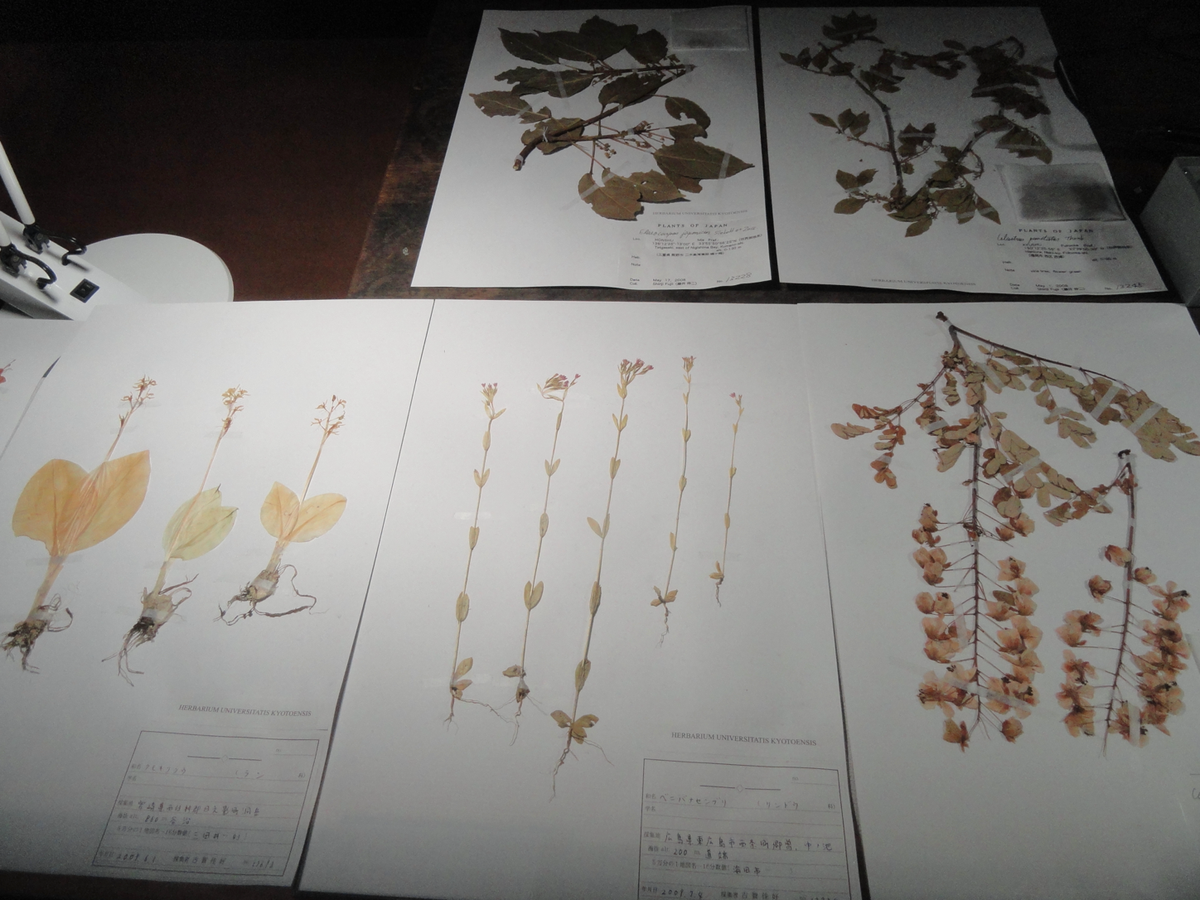
A herbarium preserves collected plant material on archival sheets together with field information. A well-prepared specimen can retain leaves, stipules, flowers, fruit, and other structures needed for later comparison. Its label records facts such as collector, date, locality, habitat, and collection number.
Researchers can revisit the same specimen when a name changes or a new question arises. Type specimens are especially important because they anchor the application of a scientific name. Digital images expand access, but the physical sheet may still preserve details, fragments, or three-dimensional structures that a screen cannot show fully.
The featured image for this article shows real herbarium specimens at the Kyoto University Museum. It illustrates the specimen-based workflow; it does not depict or identify Mitragyna.
Why old books can use different genus names
Taxonomic history leaves a trail of synonyms. Species now accepted in Mitragyna have appeared under names in genera such as Nauclea and Stephegyne. Kew also lists historical genus-level synonyms including Fleroya, Hallea, and others.
A synonym does not necessarily identify a newly discovered plant. It can record an earlier classification or a different combination of genus and species names. When consulting an older paper, the accepted-name record helps connect historical terminology to the current taxonomic treatment.
C. E. Ridsdale's 1978 worldwide revision was a major reference point. It reviewed Mitragyna and Uncaria, provided identification keys, discussed growth form and relationships, and recognized ten Mitragyna species under that treatment.
Molecular phylogeny can redraw genus boundaries
Classical taxonomy relies heavily on morphology, while molecular phylogeny compares DNA evidence to test evolutionary relationships. A 2014 study of the related tribes Hymenodictyeae and Naucleeae analyzed nuclear and chloroplast regions together with broad taxon sampling. Its results supported several tribal and subtribal groups while also showing that some traditional genus boundaries required reconsideration.
The study recovered Mitragyna within the lineage historically called Fleroya and chose a broad Mitragyna treatment in its recognized genera. More recent family-level work continues to synthesize molecular studies into an updated Rubiaceae classification. These changes are a normal part of taxonomy: names are hypotheses about relationships, tested against expanding evidence.
Related species are not substitutes for kratom
A shared genus can justify comparative botanical research. It cannot establish identical chemistry, the same concentration of any compound, equivalent processing behavior, or interchangeable finished products. Each of those questions requires species-specific and sample-specific evidence.
This boundary matters when related species appear in online discussions under informal names. A common name may vary by language and region. A seller-applied phrase may not correspond to an accepted botanical rank. Neither provides permission to relabel one species as another.
The word “kratom” in Kratom Paradise botanical content refers to Mitragyna speciosa. For the detailed species description, native range, habitat, and morphology, see Mitragyna speciosa: A Botanical Guide to the Kratom Tree.
Species, variety, cultivar, and catalog family are different fields
A species is a taxonomic unit. A botanical variety is a formally named rank below species. A cultivar is a cultivated selection maintained for particular characteristics. A catalog family is a commercial organization system. These terms should not be exchanged casually.
Red, green, white, Bali, Malay, Thai, Borneo, Vietnam, and Maeng Da names do not create additional accepted Mitragyna species. Their role in retail organization is covered in Why Kratom Strain Names Are Catalog Families. Seedlings and cuttings are explained in How Kratom Trees Reproduce.
What species-level documentation should preserve
A useful botanical identity record keeps the name connected to its evidence. Depending on the material and purpose, that may include the accepted scientific name, supplier identity, collection or source record, voucher specimen, photographs, morphological determination, DNA evidence, lot relationship, and the person or laboratory responsible for the determination.
Finished powder presents an added challenge because many visible structures have been removed by milling. A chemical assay can describe compounds in the submitted sample, but a chemistry result alone should not be treated as a complete taxonomic determination unless the method was designed and validated for that identity question. Botanical identity and chemical composition are connected records, not interchangeable records.
A concise way to read a Mitragyna name
- If only Mitragyna is given, the record is at genus level.
- If Mitragyna speciosa is given, the record states a species identity.
- If an author abbreviation follows, it records nomenclatural history.
- If another name is marked as a synonym, check which accepted name currently applies.
- If a regional or color word appears without a formal Latin rank, do not assume it describes a separate species.
- If species identity matters operationally, preserve the evidence and source relationship behind the name.
Sources and further reading
- Royal Botanic Gardens, Kew: Mitragyna
- Royal Botanic Gardens, Kew: Mitragyna speciosa
- Ngernsaengsaruay et al. (2022): Thai Mitragyna revision
- Ridsdale (1978): A revision of Mitragyna and Uncaria
- Löfstrand et al. (2014): Naucleeae phylogeny and genus limits
- Razafimandimbison et al. (2024): Rubiaceae phylogeny and classification
- Featured image: Daderot, Kyoto University Museum herbarium specimens, CC0
For botanical and taxonomic education only. Taxonomy alone does not establish the identity or composition of an unexamined sample.
Taxonomy defines the species question; laboratory methods examine different forms of evidence. Continue with How Kratom Botanical Identity Is Tested.