
Kratom & kava guides
How Kratom Trees Reproduce: Flowers, Seeds, and Cuttings
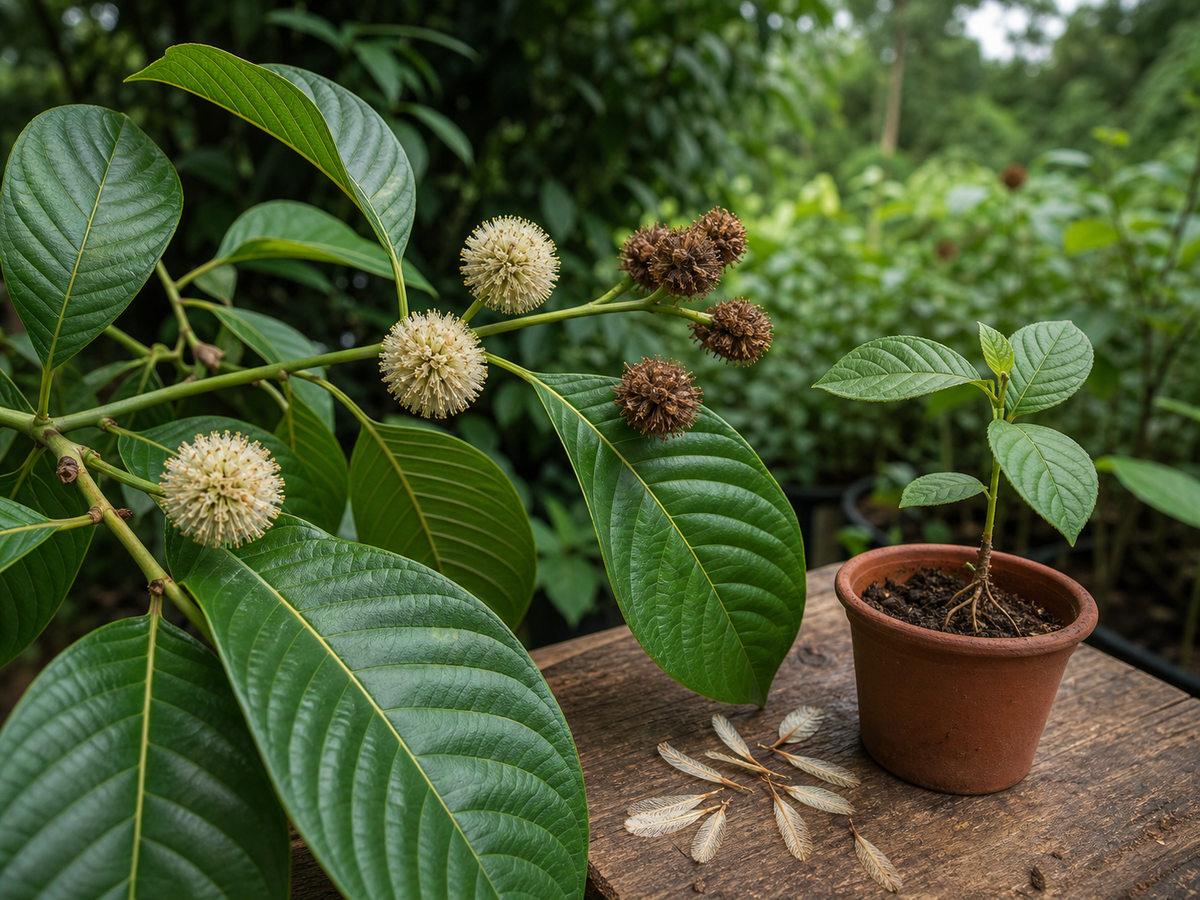
A kratom tree can begin a new generation in two fundamentally different ways. Flowers can produce seeds, combining genetic material through sexual reproduction. A stem cutting can grow its own roots, creating a vegetative descendant of one parent plant. Both routes produce Mitragyna speciosa, but they do not preserve genetic variation in the same way. That genetic difference matters because it can influence the chemistry of harvested leaf.
The reproductive cycle begins with rounded flower heads
A kratom inflorescence looks like one spherical flower from a distance, but it is a compact head made from many small flowers. A modern taxonomic treatment of Thai Mitragyna specimens described M. speciosa flower heads about 3 to 4 centimeters across. The individual flowers had creamy-white to pale-yellow tubular corollas that darkened toward yellow or orangish yellow with age.
Each small flower contains the structures involved in sexual reproduction. Pollen must reach a receptive flower and fertilization must occur before a viable seed can develop. Insect visits have been observed around cultivated flowering trees, but the published sources used here do not establish one exclusive natural pollinator for the species across its entire native range. A flower visitor, a pollen carrier, and a proven effective pollinator are not automatically the same thing.
From flowers to fruiting heads
After successful fertilization, the flower head becomes a rounded fruiting head composed of many small capsules. The Thai revision described the individual fruits as changing from green to brown and eventually brownish black as they dried. The persistent structures of the flower remain visible around the developing fruit.
Inside are numerous narrow, flattened seeds with a wing at each end. Those wings increase surface area and are consistent with dispersal away from the parent tree by moving air, although the distance and success of dispersal depend on the surrounding habitat. A seed reaching a new site has completed only the transport stage. It must still be viable, encounter suitable conditions, germinate, and survive as a seedling.
Seeds create genetic combinations
A seed-grown tree is not a photocopy of either parent. Sexual reproduction reshuffles inherited variation. Seedlings from the same fruiting population can therefore differ in visible growth, timing, architecture, and other traits. The amount and pattern of variation depend on the parents and the breeding history of the population.
This is why a regional seed label is not a complete genetic description. “Thai,” “Malay,” or “Borneo” may describe a reported collection region or a commercial name, but it does not identify both parents, confirm a controlled cross, or establish a stable botanical variety. The difference between plant variation and store naming is explained further in Why Kratom Strain Names Are Catalog Families.
What a controlled kratom seed experiment found
A University of Florida honors research project tested 1,200 seeds under controlled conditions. The experiment compared two seed sources, several media or amendments, and light exposure. In the cultivated seed group, treatments using water, peat, peat with mycorrhizal inoculum, or sucrose produced broadly similar germinability during the 21-day experiment. Seeds placed in light immediately germinated faster on average than seeds kept dark for the first seven days.
The results also showed why one percentage should not be turned into a universal rule. The cultivated seed group reached useful germination levels under several treatments, while the wild-sourced group failed to complete germination in every treatment. The authors reported fungal growth in most plates despite surface sterilization. The tested 50 ppm gibberellic acid treatment produced no completed germination in the cultivated group.
These are results for the identified seed lots, treatments, temperature, light, observation window, and laboratory setup. They do not establish that every kratom seed lot will behave the same way. Seed maturity, storage history, source identity, microbial condition, and environment can all change the result.
Germination is not the same as establishment
Botanists use germination for the beginning of seedling growth, commonly marked by emergence of the radicle and other early structures. Establishment is the longer process by which that seedling survives and becomes an independent plant. A germination count taken after days or weeks does not prove long-term survival, field performance, mature tree form, or later leaf composition.
The seed study illustrates this boundary. It measured germination parameters through 21 days and noted visible differences among young seedlings. It did not follow every plant to maturity. A careful reading keeps the time window attached to the result.
Cuttings use vegetative propagation
A stem cutting begins as living tissue removed from a parent plant. Under suitable conditions, cells near the base can form adventitious roots. Once the new root system and shoot growth are established, the cutting can continue as an independent plant.
Because a cutting comes from one parent rather than a newly formed seed, it usually preserves that parent’s genotype. That is the basis of clonal propagation. It can help researchers and growers maintain selected plant material while reducing the genetic reshuffling that occurs through seed. “Clone,” however, does not mean every later observation will be identical. Light, temperature, nutrition, water, pests, disease, plant age, sampling, and handling can still influence how genetically matched plants grow.
What the 2025 cutting study actually tested
A 2025 study in Frontiers in Plant Science compared indoor aeroponic propagation with a greenhouse mist system. One part tested cuttings from a named research cultivar under 10-, 14-, and 24-hour photoperiods over two seasons. Greenhouse mist trials ran across three seasons. A second part compared three named research cultivars in the two rooting systems, with and without an IBA and NAA rooting-hormone treatment.
In the first study, indoor aeroponic treatments produced rooting percentages from 85% to 92%, while the greenhouse mist results varied from about 7% to 98% across seasons. A 14-hour photoperiod improved several root-growth measurements compared with 10 hours. In the second study, cultivar affected performance. The hormone treatment increased root number but had limited effects on many other measured parameters.
The journal later issued a correction that replaced the aeroponic-unit illustration and fixed wording on one figure axis. The original article was updated. The numerical conclusions summarized here come from that corrected record.
Why a successful study is not a universal recipe
The cutting experiment provides strong evidence that rooting system, photoperiod, season, and plant material mattered under the conditions tested. It does not prove that one setup will produce the same percentages in every nursery, climate, cultivar, or sanitation program. The researchers also noted a potential pathogen-spread concern in a shared aeroponic system.
Greenhouse performance is especially sensitive to context. The large seasonal range in the study is evidence of variability, not evidence that mist propagation always fails or always succeeds. Likewise, the indoor result does not automatically describe propagation in a tropical field setting. Controlled rooms, Florida greenhouses, and wet Southeast Asian habitats are different environments.
Genetics and growing conditions work together
Cuttings preserve a parent’s genotype more directly than seedlings, but light, water, nutrition, plant age and later processing still influence the harvested leaf. Neither propagation method by itself establishes the strength or quality of a finished product.
For the wider taxonomic context, see Kratom’s Relatives: Understanding the Mitragyna Genus.
Where tissue culture fits
Tissue culture is another form of plant propagation carried out under sterile or highly controlled laboratory conditions. Small pieces of plant tissue may be used to produce shoots, roots, or plantlets. It can support rapid multiplication, research, and germplasm maintenance, but the exact method and its reliability are species- and protocol-specific.
Seed, stem cutting, and tissue culture should not be collapsed into one term. Seed propagation begins with sexual reproduction. A stem cutting forms new roots from an existing shoot. Tissue culture begins with an explant in a controlled culture system. Each route has different implications for genetic variation, disease management, scale, cost, and documentation.
How reproduction connects to the finished botanical
Propagation is an early chapter in a much longer chain. A rooted seedling or cutting must grow into a tree, produce leaves, and move through harvest and post-harvest handling before it becomes a commercial botanical. Drying, milling, blending, sampling, testing, and packaging occur later.
For the species, habitat, leaves, flowers, fruit, and accepted name, start with Mitragyna speciosa: A Botanical Guide to the Kratom Tree. The later physical stages are covered in From Leaf to Powder.
A practical vocabulary for reading propagation research
- Inflorescence: a flower-bearing structure; in kratom, many small flowers form a rounded head.
- Fertilization: the reproductive event that precedes seed development.
- Fruiting head: the rounded cluster of small fruits that develops after flowering.
- Germination: the beginning of growth from a viable seed under suitable conditions.
- Seedling: a young plant produced from seed.
- Cutting: a removed piece of a parent plant used for vegetative propagation.
- Adventitious root: a root that forms from non-root tissue, such as a stem cutting.
- Clone: a vegetatively propagated plant that generally carries the parent plant’s genotype.
- Cultivar: a cultivated plant selection maintained for named characteristics; the word does not automatically validate a retail strain claim.
Sources and further reading
- Ngernsaengsaruay et al. (2022): Additional knowledge on the genus Mitragyna in Thailand
- Zhang et al. (2025): Aeroponic cutting propagation of Mitragyna speciosa
- Frontiers correction to the 2025 cutting study
- University of Florida: Techniques to Maximize Germination Parameters in Kratom Seed
- Flores et al. (2020): Controlled fertility and growth study
- Royal Botanic Gardens, Kew: Mitragyna speciosa
For botanical and plant-science education only; not a cultivation guarantee, medical advice, or packaged product specification.
Plant age, genetics, environment, and sample history also shape the evidence researchers can collect. Read Why Kratom Research Is Difficult.