
Kratom & kava guides
Wild-Harvested vs Cultivated Kratom: What the Labels Can—and Cannot—Show
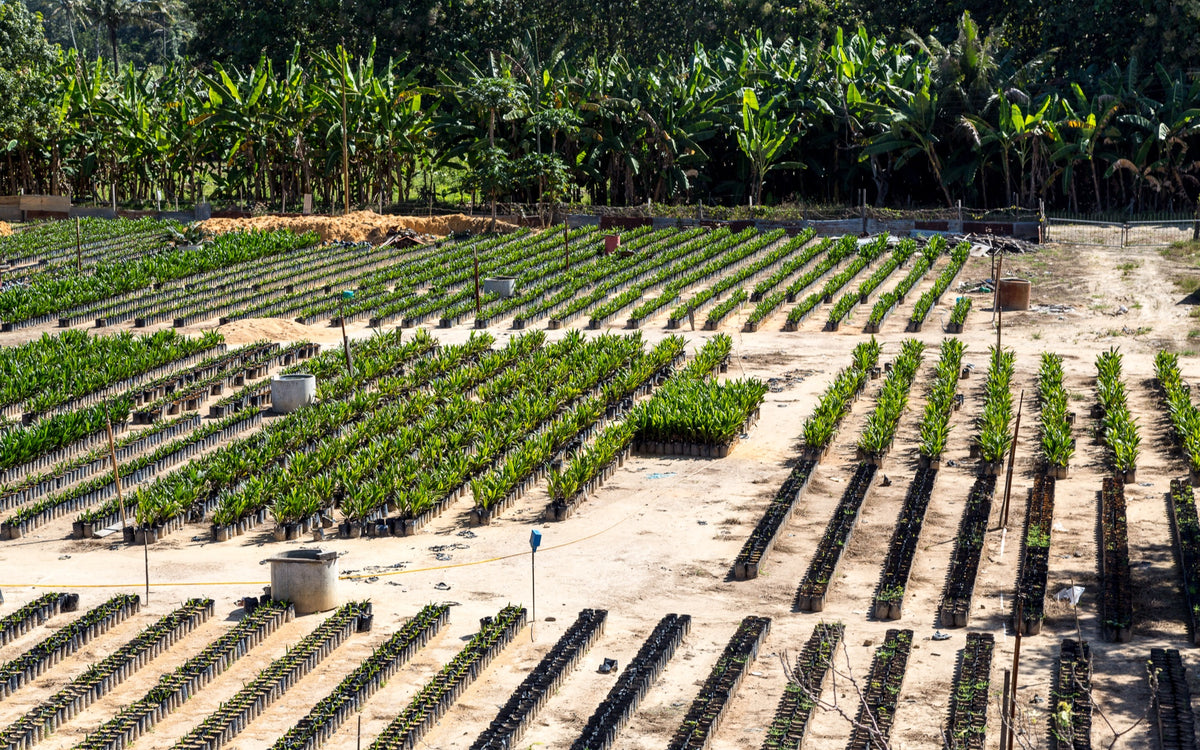
“Wild-harvested” and “cultivated” describe where kratom trees came from and how people managed them. They are not opposite ends of a potency scale. A naturally occurring tree may still be pruned and protected, while cultivated kratom can range from household trees to agroforestry systems and planted fields.
What “wild-harvested” should mean
In its strictest sense, wild-harvested kratom comes from Mitragyna speciosa populations that exist and reproduce without being intentionally planted as a crop. People collect leaves from those trees rather than raising them in a field or nursery.
The Food and Agriculture Organization notes that “wild” products are often managed to some degree and that management exists along a gradient from low-intensity gathering to global bulk trade. A naturally occurring tree may be pruned, protected from competing vegetation, repeatedly harvested, or included within a customary collection area. Human management does not always begin with planting.
What “cultivated” can include
Cultivated kratom is deliberately established or managed for production. The category includes more than a uniform plantation:
- Home-garden trees: one or several planted trees near a house or within a household garden.
- Retained farm trees: naturally occurring trees intentionally kept and managed when surrounding land is farmed.
- Agroforestry: kratom grown with other trees, crops, or sometimes animals in an integrated system.
- Orchards or planted stands: multiple trees established primarily for leaf harvest.
- Nursery production: seedlings or cuttings raised before planting at another site.
The FAO definition of agroforestry centers on deliberate integration of woody perennials with crops or animals. A mixed home garden and a single-crop field are both cultivated, but they differ in structure, labor, inputs, and potential landscape effects.
The middle categories make the binary unreliable
Many tree crops move between wild collection, protection, enrichment planting, semi-domestication, and full cultivation. Kratom can do the same. A tree may have germinated naturally and later been adopted into a farm. Seedlings may be planted beside older local trees. Leaves from several small gardens may be combined with material from a managed riverside stand.
A one-word source label can hide those mixtures. Ask how the material was produced and whether the lot combines leaf from more than one site or source type. If origins were combined, the label should not suggest that every leaf came from a single untouched forest.
Documented kratom settings are already diverse
A qualitative study of men in southern Thailand reported that many regular consumers kept one or two kratom trees near rubber plantations, rice fields, fruit gardens, house yards, ditches, or fishing ponds. Those trees were part of lived and managed landscapes rather than a clean “forest versus farm” split.
Research in Kapuas Hulu, West Kalimantan, describes cultivation on alluvial land and river banks. A 2024 soil survey studied one mineral-soil field and one peat field planted with kratom. Other local studies describe farmers growing and selling kratom as a household income source. These records confirm cultivated production, but two fields or one village cannot characterize every Indonesian supply source.
The kratom ethnobotany overview keeps community practices attached to the people and places studied. The Indonesia farming and export-economics overview follows the smallholder and trade context.
A regional name is not a harvest record
Words such as Borneo, Bali, Malay, Thai, Hulu, or Maeng Da may function as catalog-family names. They do not independently prove a farm, forest, country, or collection site. The accepted native range of Mitragyna speciosa is broad, and the international supply chain may combine material before it reaches a retail package.
Geographic origin needs its own documentation: source-party identity, collection or farm location, harvest dates, transfer records, and lot codes. Why Kratom Strain Names Are Catalog Families separates color and geography-style retail labels from botanical and supply-chain facts.
What verifies a wild-harvest claim
A credible wild-harvest record is site-specific. It can include:
- confirmation that the collected species is Mitragyna speciosa;
- a mapped collection area and the party authorized to use it;
- land-tenure, legal-access, protected-area, and customary-rights checks;
- a population assessment covering mature trees, younger trees, and regeneration;
- a harvest method, frequency, and maximum removal level;
- monitoring for damage, mortality, recruitment, and changes in the wider habitat;
- collector identity, training, labor terms, and payment records; and
- chain-of-custody records from collection through drying and lot formation.
The FairWild Standard organizes comparable evidence around conservation of the collected species, effects on the collection area, human rights, customary rights, fair arrangements, legal compliance, and responsible business. The word “wild” alone covers none of those requirements.
What verifies a cultivated claim
Cultivated-source documentation begins with the farm or managed parcel. Useful records identify who operates it, how the trees were established, whether seedlings or cuttings were used, neighboring land uses, harvest dates, and any irrigation, fertilizer, or crop-protection inputs.
Land history is essential. A long-established orchard, a mixed garden, and a field created through recent habitat clearing are all cultivated, yet they carry different environmental implications. Dated maps, field inspections, parcel documents, and supplier agreements can address conversion risk more directly than the cultivated label itself.
The kratom reproduction guide explains seedlings and cuttings as biological pathways. It does not turn a propagation method into a quality grade.
Neither source type predicts chemistry
Kratom alkaloid composition can vary with genetics, geography, season, leaf material, tree condition, and post-harvest handling. A Thai study of naturally growing trees on private properties compared plants from four regions and found variation in growth, leaf traits, and mitragynine content. The authors also emphasized the limited number of trees and uncontrolled field conditions.
A larger Thai project analyzed 745 samples collected across locations and seasons and reported seasonal and geographic variation in mitragynine, paynantheine, and speciogynine. A separate genome study assessed 85 accessions from 15 Thai provinces and found genetic structure within the species. Together, these studies show that the tree is biologically variable. They do not establish a universal “wild profile” or “cultivated profile.”
Once leaves are pooled, dried, milled, or extracted, post-harvest choices add more variables. Lot-specific analytical results are the direct way to report measured chemistry. The kratom alkaloid guide explains what those measurements represent.
Neither source type predicts human effects
People can experience stimulating or relaxing effects from kratom, and regular use can lead to dependence. Wild harvesting does not guarantee a particular experience, while cultivation does not make the leaf inactive or synthetic. The tree is the same accepted species when identity is confirmed.
Effects also depend on concentration, amount, other ingredients, other substances, individual physiology and pattern of use.
Neither source type guarantees purity or safety
Wild leaves can be exposed to soil, floodwater, animals, dirty collection containers, or uncontrolled drying surfaces. Cultivated leaves can be affected by soil contaminants, agricultural inputs, irrigation water, workers, tools, and storage conditions. Both move through handling and processing steps where microorganisms, metals, foreign material, or mix-ups can enter.
Botanical identity and representative contaminant testing remain necessary for either source. A certificate of analysis should identify the tested sample, method, result, date, and connection to the retail lot. The kratom COA guide shows how to make that connection.
“Wild” is not automatically more sustainable
Wild collection can create an incentive to retain trees and habitat when the resource is managed, rights are respected, and collectors receive durable value. It can also damage a population when demand rises faster than monitoring, when too much foliage is removed, or when access and payment arrangements encourage short-term extraction.
Cultivation can reduce pressure on wild populations and support predictable production. It can also involve habitat conversion, single-crop land use, concentrated inputs, or unequal contracts. The result depends on the site and management system. The kratom sustainability and conservation guide covers land, harvest, labor, processing, packaging, and freight evidence across both systems.
“Old-growth” and “ancient tree” need exceptional proof
Age language is especially difficult to verify after leaves have been milled. Tree age might be supported by planting records, long-term local knowledge, repeated field documentation, or a validated age-estimation method. A photograph of a large trunk does not connect that tree to a retail lot, and size alone is not a precise age measurement.
Even when a source tree is old, age does not guarantee stronger leaf, better effects, freedom from contaminants, or sustainable harvest. Claims such as “centuries old,” “untouched,” and “deep forest” should be treated as factual assertions requiring source-specific evidence.
Questions buyers can ask
- What definition of wild-harvested or cultivated is being used?
- Can the retail lot be traced to a farm, collection area, supplier group, and harvest period?
- Was the material pooled from wild, semi-managed, garden, and orchard sources?
- For wild material, who assessed the population and set the harvest level?
- For cultivated material, what was the parcel’s prior land use and how were trees established?
- How are collector rights, worker conditions, pricing, and payment documented?
- What drying, storage, identity, chemistry, microbial, and heavy-metal records attach to the lot?
- Which parts of the sourcing claim were independently verified, and on what date?
Sources and further reading
- FAO: Non-wood forest products, wild terminology, and management gradients
- FAO: Agroforestry overview and definitions
- FairWild Foundation: Standard 3.0 overview
- World Health Organization: Good agricultural and collection practices for medicinal plants
- Royal Botanic Gardens, Kew: Mitragyna speciosa
- Saingam et al. (2013): Kratom trees and use in southern Thai village settings
- Suryadi, Indrawati, and Junaidi (2024): Soils under kratom cultivation in Kapuas Hulu
- Leksungnoen et al. (2022): Naturally growing kratom populations across four Thai regions
- Phuphuakrat et al. (2023): Seasonal and geographic variation in 745 Thai kratom samples
- Brose et al. (2022): Genome assembly and genetic diversity in 85 Thai accessions
- Kusnadi, Muin, and Roslinda (2022): Kratom farming and household income in Ulak Pauk Village
This material is provided for sourcing, botanical, and product-documentation education. It is not medical advice or proof of any individual product claim.