
Kratom Alkaloids Explained: Mitragynine, 7-Hydroxymitragynine, and Minor Compounds
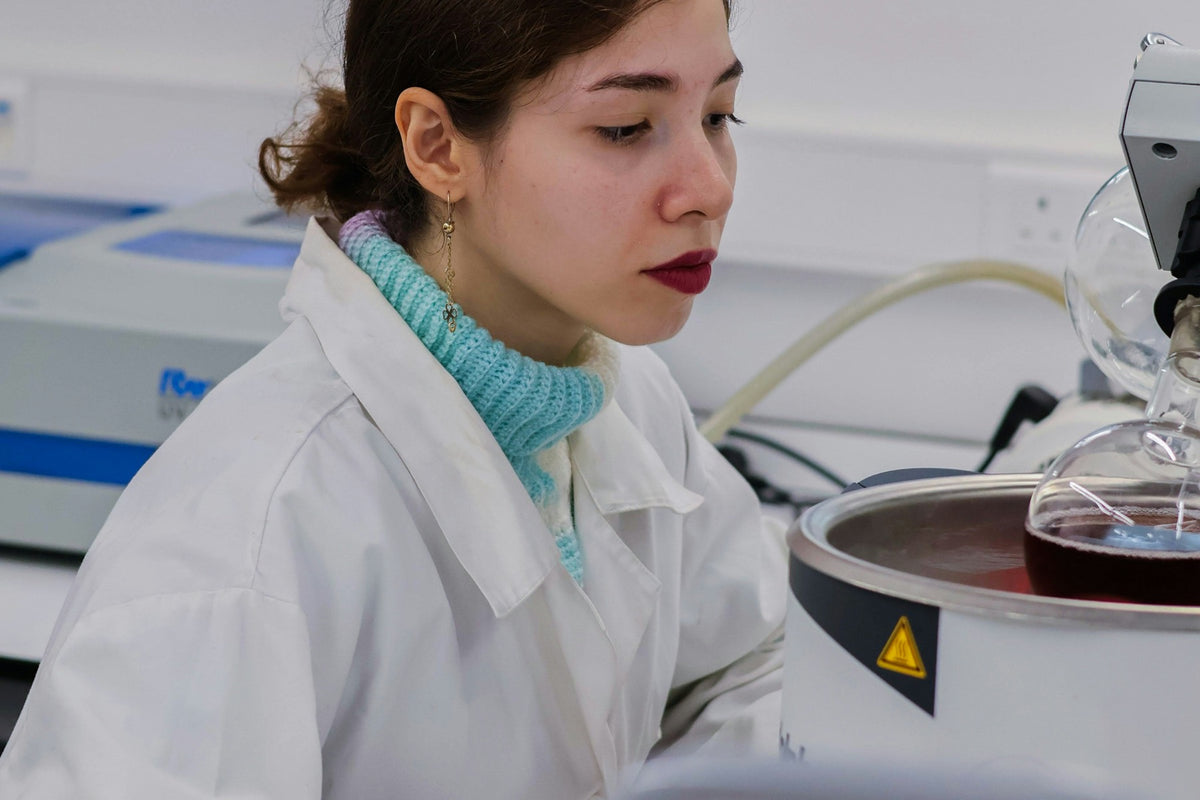
People consume kratom leaf and extracts because the plant’s alkaloids are psychoactive. Reports commonly include increased energy or alertness, pain relief, relaxation, sedation, and attempts to manage opioid withdrawal. Unwanted effects can include nausea, dizziness, constipation, sweating, drowsiness, tolerance, dependence, and withdrawal. Those experiences vary with the person, amount, product composition, and other substances.
Two compounds are central to understanding why: mitragynine, usually the principal alkaloid in dried leaf, and 7-hydroxymitragynine, commonly shortened to 7-OH. Both interact with opioid receptors, but 7-OH has stronger mu-opioid-receptor activity. Natural leaf generally contains little 7-OH relative to mitragynine, while enriched 7-OH products can create a very different exposure.
An alkaloid profile shows which compounds a laboratory measured in one sample. Connecting that chemistry to human effects requires pharmacology, metabolism, product identity, and human evidence as well as the number printed on a report.
What is an alkaloid?
Alkaloids are nitrogen-containing organic compounds made by many plants. Caffeine, nicotine, quinine, and morphine are familiar examples from other botanical sources, although they are chemically and pharmacologically different from kratom alkaloids. The category describes a broad feature of chemical structure; it does not imply that all alkaloids behave alike.
Researchers have reported dozens of alkaloids in Mitragyna speciosa. The exact list depends on the plant material, extraction procedure, instrument, reference standards, and the threshold used to identify a compound. A paper that targets ten named alkaloids may provide more reliable quantitative data for those ten than a broad untargeted screen, while the broader screen may reveal additional candidates that require confirmation.
Mitragynine is usually the principal reported leaf alkaloid
Mitragynine is generally the most abundant alkaloid reported in dried kratom leaf. Its prominence is why many research papers and commercial laboratory panels use it as a central marker. In a 2019 study of commercially available products, researchers used liquid chromatography with high-resolution mass spectrometry to identify and quantify ten kratom alkaloids, with substantial variation among samples.
“Principal” does not mean exclusive. A plant sample can contain mitragynine alongside many minor alkaloids, and a numerical result still belongs to the exact submitted material. A value measured in raw leaf powder cannot automatically be transferred to an extract, tablet, liquid, or different lot.
How mitragynine affects opioid signaling
Cell studies have found that mitragynine can activate the human mu-opioid receptor as a partial agonist and can interact with other opioid and adrenergic targets. “Partial” describes its maximum signaling response in a particular assay relative to a reference full agonist; it does not mean the compound is only partly active in a person.
Mitragynine is also metabolized. Human liver preparations convert some mitragynine to 7-OH through CYP3A enzymes, and controlled oral-administration studies have measured both compounds in human blood. In a six-person study, mitragynine generally reached maximum measured concentration within one to two hours and showed a long terminal half-life. A later repeated-administration study found accumulation over several days.
This pharmacology helps explain why kratom can produce opioid-like effects and why interactions matter. In 12 healthy adults, a characterized kratom tea increased midazolam peak concentration by about 50% and total exposure by about 40%, consistent with inhibition of intestinal CYP3A. It did not meaningfully change dextromethorphan exposure in that experiment.
What is 7-hydroxymitragynine?
7-Hydroxymitragynine is a distinct oxidized derivative and active metabolite of mitragynine. Receptor and animal studies show stronger mu-opioid activity than mitragynine, including antinociception and slowed gastrointestinal transit in mice. Concentrated 7-OH can therefore produce opioid-like effects and risks at exposures that ordinary leaf chemistry does not represent.
In unprocessed leaf, 7-OH is generally reported at much lower levels than mitragynine and may be absent or below a method’s reporting limit. Processing, storage, oxidation, enrichment, or deliberate formulation can produce a very different chemical profile from the starting leaf. Semi-synthetic and enriched products have been associated with rapid tolerance, dependence, withdrawal, and substance-use-disorder cases.
This distinction is central to current federal action. In July 2026, the U.S. Drug Enforcement Administration announced its intent to temporarily schedule 7-hydroxymitragynine and related substances. DEA and the Federal Register notice describe the compounds and scope of that action; they should be consulted directly for the operative wording and dates. The current status is summarized on the Kratom Paradise DEA 7-OH scheduling tracker.
The regulatory focus on concentrated or enriched 7-OH products should not be collapsed into a claim that every kratom leaf or every mitragynine material has the same composition. FDA’s 2025 scientific assessment likewise distinguishes highly concentrated 7-OH products from the much lower concentrations it describes in natural leaf material. That is an agency assessment, not a substitute for reading a product-specific laboratory record.
Mitragynine and 7-OH are related but not interchangeable
The names are chemically related, yet laboratories treat them as separate analytes. Each needs its own reference standard, calibration, retention behavior, mass-spectral evidence, reporting limit, and result. A report that measures mitragynine does not necessarily measure 7-OH, and a “total alkaloids” statement does not disclose either value unless the underlying method defines the total.
The two compounds also should not be treated as equivalent merely because a percentage or milligram value appears beside each name. The same number can describe different material bases: percentage by weight in a dry powder, milligrams per tablet, milligrams per container, or concentration per milliliter. The analyte and unit must stay attached to the result.
The distinction is pharmacological as well as analytical. Consuming leaf exposes a person to mitragynine, minor alkaloids, and any 7-OH present or formed during metabolism. Consuming an enriched 7-OH product directly supplies a more potent mu-opioid agonist. That is why “kratom,” “MIT,” and “7-OH” cannot be treated as effect-equivalent labels.
Minor kratom alkaloids add chemical complexity
Research literature has reported compounds such as speciogynine, paynantheine, speciociliatine, corynantheidine, mitraciliatine, isopaynantheine, and several oxindole alkaloids. “Minor” refers to relative abundance in a particular context, not importance, certainty, or biological effect. Some compounds are difficult to separate from closely related isomers, and not every laboratory panel includes the same list.
The 2019 ten-alkaloid analysis found that commercial samples varied in both the presence and relative abundance of named constituents. A 2022 chemotype study likewise reported chemical diversity among samples and examined whether alkaloid patterns could be grouped. Such groupings are research tools. They do not create universal retail categories or prove that a marketing name corresponds to a reproducible chemical profile.
Some minor alkaloids bind or signal at opioid or other receptors in laboratory assays, while others remain poorly characterized. Their presence may contribute to the experience of a complex leaf product, but the size and direction of those contributions in humans are not well established. “Full spectrum” therefore describes neither a known effect nor a complete pharmacological model unless the actual compounds and evidence are specified.
Why plant samples do not all have the same profile
Botanical chemistry can vary with genetics, geography, season, leaf maturity, cultivation conditions, harvest, drying, storage, and subsequent processing. The relative contribution of each factor is not always known, and observations from one collection cannot establish a universal rule. Even leaves from the same species can show meaningful chemical variation.
Sample handling adds another layer. Heat, light, oxygen, moisture, extraction solvents, and storage time can affect chemical stability or recovery. A valid comparison therefore needs enough documentation to determine whether the samples were alike in origin, format, preparation, and age.
Product format changes the analytical question
Whole leaf, milled powder, extract powder, liquid extract, flavored tablet, and gummy are different analytical matrices. A matrix is the complete material surrounding the target compound. Sugars, acids, colors, binders, solvents, and other ingredients can change how a sample must be prepared and how well an analyte can be recovered.
An extract intentionally concentrates selected soluble material relative to starting leaf. That makes a result from the extract a description of the extract, not evidence that the leaf naturally contained the same percentage. Finished products may also require a separate calculation to connect concentration, unit weight, and package count. The extract powder and liquid format guide explains why percentages, bottle volumes, and unit-level values must be compared on their original basis.
How laboratories separate and identify alkaloids
Many modern kratom studies use liquid chromatography. The instrument passes a prepared sample through a column, where compounds separate according to their interactions with the stationary phase and solvent system. A detector records the compounds as they leave the column. Ultraviolet or diode-array detectors can measure absorbance, while mass spectrometers provide mass-to-charge information that helps identify chemical species.
Retention time and accurate mass are useful, but closely related compounds can still be confused. Isomers may share the same molecular formula and produce similar fragments. A 2026 analytical study reported that a compound previously assigned as mitragynine pseudoindoxyl in a kratom extract was instead an isomer, illustrating why reference standards and orthogonal evidence matter. A confident name requires more than a database match.
Identification and quantification are different steps
Identification asks which compound produced a signal. Quantification asks how much of that compound was present. Quantification normally uses a calibration curve prepared from known concentrations of an appropriate reference standard. Laboratories also evaluate selectivity, accuracy, precision, recovery, linearity, and detection or quantification limits as relevant to the method.
A result below the limit of quantification is not the same as confirmed zero. “Not detected” means the laboratory did not detect the analyte under the stated method and reporting conditions. Another method with a lower limit or different sample preparation could produce a different result.
Common units on alkaloid reports
- Percent by weight: grams of analyte per 100 grams of the stated material basis.
- Milligrams per gram: mass of analyte per gram of sample; 10 mg/g is numerically equivalent to 1% by weight when the basis is the same.
- Milligrams per unit: an amount calculated or measured for one tablet, capsule, gummy, or other defined unit.
- Milligrams per milliliter: concentration in a liquid volume.
- Below LOQ or ND: method-dependent reporting terms rather than universal statements of absence.
Conversions are valid only when the material basis and necessary measurements are known. A percentage does not reveal the amount in a tablet without the relevant tablet mass, and a liquid concentration does not reveal the amount in a bottle without its verified volume.
Alkaloid panels do not replace botanical identity tests
A chemical profile can support identity work, but it is not automatically conclusive. Related Mitragyna species may share compounds, and processing can change a profile. Botanical identity may draw on taxonomy, authenticated references, microscopy, DNA methods, or multiple complementary approaches depending on the sample.
The difference is explained in How Kratom Botanical Identity Is Tested. A complete quality record may combine identity, composition, contaminant testing, and traceability rather than asking one panel to answer every question.
How to read an alkaloid result in context
Start with the sample description and ask whether the report covers leaf, extract, or a finished product. Then confirm the laboratory, report number, dates, analyte list, method, units, reporting limits, and any qualifiers. Match the report to a lot or production record when that connection is provided.
Next, separate measured findings from interpretation. “The laboratory reported 60% mitragynine by weight in the submitted extract powder” is a bounded statement. “All products made from this material always contain the same amount” requires additional manufacturing and finished-product evidence. The Kratom COA guide provides a field-by-field reading method, while the quality and lab testing guide shows how composition fits with identity and contaminant records.
Questions a single alkaloid number cannot answer
- Whether the botanical material was correctly identified.
- Whether heavy metals, microorganisms, pesticides, or solvents were examined.
- Whether the submitted portion represented an entire lot.
- Whether another product format has the same composition.
- Whether a marketing term has a standardized scientific meaning.
- What legal status applies in a particular place or on a future date.
Keeping those questions separate prevents a chemistry result from carrying more weight than its method and sample can support.
A practical alkaloid-profile checklist
- Identify the exact compound, sample, format, and lot.
- Preserve the original unit and material basis.
- Confirm whether the method measured mitragynine, 7-OH, and named minor alkaloids separately.
- Look for reporting limits and qualifiers, especially beside ND or below-LOQ results.
- Distinguish a source-material report from a finished-product report.
- Use current primary agency records for regulatory status.
Sources and further reading
- FDA: 7-Hydroxymitragynine assessment
- Sharma et al. (2019): Identification and quantification of ten kratom alkaloids
- Manwill et al. (2022): Kratom alkaloid chemotypes
- Todd et al. (2020): Chemical and biological study of kratom alkaloids
- Kruegel et al. (2019): Conversion of mitragynine to 7-hydroxymitragynine
- Tanna et al. (2022): Human kratom alkaloid pharmacokinetics
- Tanna et al. (2023): Controlled kratom-drug interaction study
- Hill et al. (2026): Isomer identification in kratom extracts
- DEA: Temporary-scheduling announcement
- Federal Register: Temporary-placement notice