
Kratom & kava guides
Kratom Chemistry Across the Growing Cycle: Leaf Age, Season, and Harvest
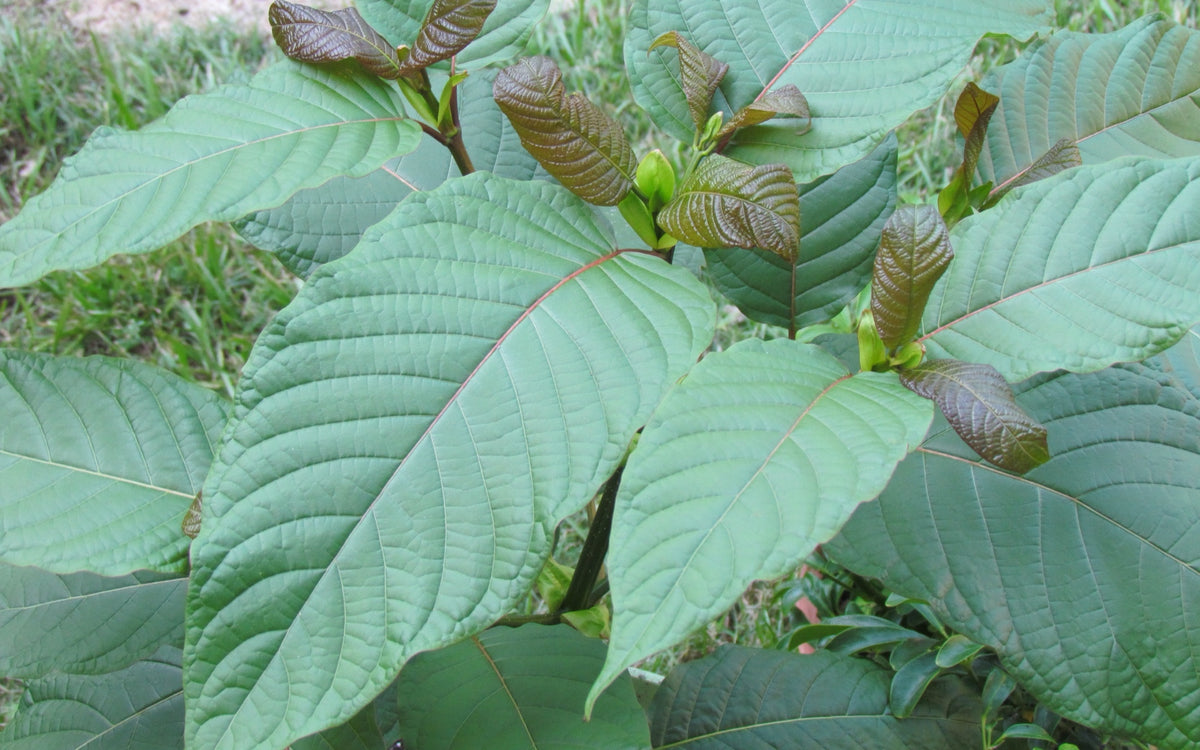
Kratom chemistry changes while a leaf develops and can continue changing after harvest. In a 2023 study of five leaf stages, mitragynine increased about three-fold as the measured leaves matured while corynantheidine declined about eighteen-fold. A separate Thai study analyzed 745 samples and found seasonal and geographic differences. Other experiments show that light, water stress, drying, and plant genetics can alter the measured profile.
Those findings undermine retail shortcuts such as “older leaf is always stronger” or “red veins create one predictable effect.” Kratom is psychoactive, but leaf age, tree age, harvest date, vein color, and powder color are different variables—not shortcuts to a guaranteed experience. Only testing can show the chemistry of a particular production lot.
Tree age, leaf age, and harvest date are different variables
A mature tree continuously produces new leaves. One branch can hold a small unfolding leaf near its tip, expanding leaves below it, and older fully developed leaves farther from the meristem. “Tree age” describes the whole plant. “Leaf age” or developmental stage describes an individual organ. “Harvest date” places collection in a season and weather history. None can stand in for the others.
Field studies often estimate tree age from owner reports because Mitragyna speciosa does not provide a simple annual-ring count. Laboratory studies may define leaf stages by length or by position along a shoot. Commercial descriptions rarely state either method. An “old tree” claim therefore does not reveal whether the harvested material came from newly expanded leaves, mature leaves, mixed canopy material, or several trees.
Alkaloid balance changes while a leaf develops
A 2023 University of Florida study quantified ten alkaloids across five leaf stages: three juvenile size classes, a medium class, and mature leaves. Corynantheidine and speciociliatine were most prominent in the juvenile tissues, while mitragynine became dominant in medium and mature leaves. Across the measured progression, corynantheidine declined about eighteen-fold and mitragynine increased about three-fold. Speciogynine and paynantheine rose alongside mitragynine. 7-Hydroxymitragynine remained low to negligible at every stage in that plant material.
A separate 2023 Malaysian metabolomics study compared young and mature leaves collected at the same locality and time. It found clear overall separation between the two metabolite profiles. Among the tentatively identified features, many alkaloids differed by stage. Relative mitragynine signal was about 1.2 times higher in mature leaves and the relative 7-hydroxymitragynine signal about 3.3 times higher. Because much of that work used untargeted mass-spectrometry annotation, the authors noted that authentic standards or stronger structural evidence would be needed for some proposed identities.
These studies provide direct kratom-specific findings. They also show why “mature leaf” needs a definition: one study followed five size classes in cultivated material and quantified a targeted panel, while the other compared two age groups and profiled a much wider set of features.
Development can matter more than visible differences among plants
A 2026 study examined eight authenticated M. speciosa accessions originating from central and southern Thailand. The plants differed in leaf shape, margins, and vein color, and DNA markers separated them into two haplotypes. Researchers quantified seventeen alkaloids in juvenile leaves under 4 centimeters and in mature leaves.
Developmental stage had the larger overall effect on the measured alkaloid pattern. Juvenile leaves accumulated strictosidine and several upstream or 3R-configured compounds, while mature leaves shifted toward mitragynine and other 3S-configured alkaloids. Mature-leaf mitragynine reached up to 1.19% of dry mass, while juvenile speciociliatine reached up to 1.14%. Mature tissues showed no significant overall alkaloid differences among the eight accessions in that experiment.
That result does not mean genetics never matters. It means leaf stage explained more of this particular comparison than accession did under the conditions examined.
There is no universal “older leaf is stronger” rule
The five-stage Florida work found mitragynine increasing as its leaves matured. The 2026 Thai-accession study found the same broad developmental shift. Yet a 2025 hydroponic experiment reported higher mitragynine in its second- and third-pair leaves than in leaves farther down the shoot. Another field study of established Thai trees also reported higher values in early leaf pairs than in older ones.
Those findings are not interchangeable definitions of “young” and “mature.” A tiny newly emerged blade, a fully expanded second-pair leaf, and an older lower-canopy leaf occupy different developmental positions. Genetics, plant age, light exposure, water status, sampling position, and analytical basis also differed among experiments. The defensible conclusion is that development changes alkaloid balance—not that maximum chemistry always occurs at one universal leaf age.
Leaves, stipules, stems, and roots have distinct profiles
The same 2023 whole-plant study compared several tissues. Leaves contained the greatest total concentration of the ten targeted alkaloids at about 1.73% of dry weight, followed by stipules at 1.13%, stems at 0.29%, and roots at 0.20%. Mitragynine was highest in leaves, lower in stipules and stems, and not detected in roots. Speciociliatine was prominent in stipules and stems and was detected in roots.
A plant-part result is not a leaf specification. Bark, root, stem, stipule, and leaf cannot be pooled under the word “kratom” when the tissue identity changes the chemical question. For ordinary leaf products, an ingredient record should identify leaf material rather than relying on the species name alone.
Genetics can create real chemotypes without validating retail “strains”
DNA and chemistry studies show genuine variation within M. speciosa. A chromosome-scale genome project assessed 85 accessions from 15 Thai provinces and found population structure within the species. The 2023 Florida germplasm study found cultivars ranging from undetectable to high mitragynine and identified genetic evidence consistent with hybridization in some low-mitragynine plants. The 2026 Thai study found two haplotypes among its eight accessions.
A stable genetic line requires direct parentage or genomic evidence for the material in the pouch. Commercial leaf can combine many trees and farms, while names such as Red Bali, Green Malay, and Maeng Da do not document parentage. The guide to kratom strain and color names separates catalog families from botanical varieties and measured chemistry.
Season and geography changed alkaloids in a 745-sample Thai study
A large Thai project measured mitragynine, paynantheine, and speciogynine in two collection programs. The first included 134 samples from one Surat Thani subdistrict collected in June 2019, October 2019, and January 2020. The highest individual mitragynine result was 4.94% by weight in June, and the lowest was 0.74% in October. Across that collection, the June group was highest, January intermediate, and October lowest.
The second program collected 611 samples from 13 provinces during June–August 2021, October–December 2021, and January–April 2022. Where possible, samples were taken from the same trees across periods. Mitragynine ranges were 0.35–3.46%, 0.31–2.54%, and 0.48–2.81%, respectively. The June–August group again contained more of the three measured alkaloids on average than the later groups.
Those data establish seasonal and geographic variation in the sampled Thai trees. They do not create a universal “June harvest” grade. The periods also differed in rainfall, temperature, tree location, soil, and other conditions. A lot harvested in another country, year, microclimate, or genetic population needs its own result.
Light and water can shift growth and chemistry in different directions
A Florida radiance study found the highest mitragynine concentration and greatest total leaf production in young cloned plants under a shaded greenhouse treatment. An observational study of mature Thai trees instead associated higher light and greater soil water content with higher mitragynine across its field sites. The authors identified plant stage and uncontrolled field variation as important explanations for the difference.
The 2025 hydroponic experiment separated three light levels and three water-potential treatments in seedlings. Water potential had the stronger overall effect. Mild stress produced the highest mean mitragynine result, while severe stress reduced growth and mitragynine. Younger leaf pairs also differed from older leaves. These findings show that environment, development, and chemistry interact; they do not show that stressing a tree is a reliable way to improve a packaged product.
The companion kratom cultivation-conditions guide covers the field, greenhouse, and hydroponic evidence in full.
Harvest timing needs a complete sampling description
A useful harvest record states what was collected, not only when. The 2025 postharvest study selected healthy second- or third-pair leaves from similar branch positions before mixing them into composite samples. The 745-sample Thai project recorded collection period, location, vein appearance, and tree information. Other developmental studies defined leaves by length.
Those controls prevent a seasonal comparison from becoming a hidden comparison of leaf ages or tissues. The studies reviewed here do not establish one best hour of the day for harvesting. A claim about morning, evening, moon phase, or a single “peak” month needs a kratom-specific experiment that holds plant identity, leaf position, weather, and handling constant.
Vein color did not reliably separate chemistry
The 134-sample Thai collection included both red- and green-veined plants and found the three measured alkaloids distributed consistently across vein colors within each period. In the 611-sample extension, vein color again did not produce a stable chemical division. The 2026 accession study likewise found visible vein differences without significant mature-tissue alkaloid differences among its plants.
Veins can appear red, reddish-green, or green, and young reddish tissue can turn green as it develops. A color word may remain useful for organizing a catalog, but it does not report mitragynine, minor alkaloids, harvest stage, or expected effects.
Chemistry continues changing after the leaf is cut
Harvest does not instantly stop every biological and chemical process. A 2025 controlled study followed two cultivars harvested in summer and winter, then compared withering duration and drying temperature. In one cultivar, a 12-hour wither increased mitragynine in several treatment combinations, while extending withering to 24 or 72 hours did not provide a consistent further increase. In the other cultivar, withering had a smaller and more condition-specific effect. Drying at 25°C generally preserved more mitragynine than drying at 60°C, but individual minor alkaloids responded differently.
Season also changed the pattern of 7-hydroxymitragynine detection, and the two cultivars did not move together. In the “Hawaii” material, more summer samples were above the method’s quantification limit; in “MR-Malaysian,” winter samples were more often quantifiable. The authors concluded that genotype, season, and postharvest handling all contributed.
A separate 2024 fresh-leaf study stored young and mature leaves from two cultivars for 12 days at either 10°C or about 30°C. Mature leaves began with more mitragynine than young leaves. Storage at 10°C caused chilling injury, browning, membrane damage, and loss of mitragynine and other measured compounds in that setup. Refrigeration was not automatically protective simply because it was colder.
The physical sequence from harvest through drying and milling appears in From Leaf to Powder. The growing-cycle question here is narrower: a harvest result cannot be interpreted without the handling that followed it.
Powder color is not a chemical assay
The 2025 withering and drying experiment photographed visibly different powders across its processing treatments. Statistical comparisons did not support powder color as a substitute for the measured alkaloid profile. Heat exposure, drying, oxidation, and leaf pigments can change appearance without producing a simple one-to-one relationship with mitragynine or another named compound.
A redder, greener, darker, or lighter powder therefore needs the same analytical support as any other lot. Color is an observation; alkaloid concentration is a measurement.
A harvest story cannot replace a batch result
“Mature leaf,” “summer harvest,” “old-growth,” “shade grown,” and “single origin” can each describe part of a story. None states the actual amount of mitragynine, 7-hydroxymitragynine, or a minor alkaloid in the finished package. None establishes botanical identity, microbes, heavy metals, pesticides, or adulterants.
After harvest, leaves may be pooled across trees, farms, dates, or drying runs. Milling and blending reduce visible differences while creating a new composite lot. Representative sampling and lot-specific analysis are the direct ways to describe that material. The kratom COA guide explains how analytes, units, methods, dates, and lot codes connect.
A useful growing-cycle record keeps the variables attached
- Plant identity: authenticated species, accession or parent source, and propagation pathway.
- Plant stage: estimated tree age, health, canopy position, and prior management.
- Leaf stage: a defined length, leaf-pair position, expansion state, and included tissue.
- Environment: site, season, rainfall, temperature, humidity, light, soil water, and nutrients.
- Harvest: date, time if relevant, collector, selection criteria, damage, and amount.
- Postharvest: delay before handling, withering, drying temperature and duration, storage, milling, and blending.
- Sampling: individual versus composite material, number of trees, lot boundaries, and sampling plan.
- Analysis: named analytes, validated method, standards, dry- or as-is basis, reporting limits, and result.
The batch and sample-ID guide shows how those records stay connected after the leaf becomes a packaged lot. For the compounds and their human pharmacology, see Mitragynine, 7-Hydroxymitragynine & Other Kratom Alkaloids.
Sources and further reading
- National Institute on Drug Abuse: Kratom effects and research overview
- Laforest et al. (2023): Tissue, development, genetics, and targeted kratom alkaloids
- Veeramohan et al. (2023): Young- and mature-leaf comparative metabolomics
- Ransden et al. (2026): Thai accessions, leaf development, and seventeen alkaloids
- Brose et al. (2022): Kratom genome assembly and diversity across 85 Thai accessions
- Sengnon et al. (2023): Seasonal and geographic variation across 745 Thai samples
- Leksungnoen et al. (2022): Environment and mitragynine in mature Thai trees
- Zhang et al. (2022): Radiance, plant growth, and leaf alkaloids
- Leksungnoen et al. (2025): Light, water potential, leaf age, and mitragynine in seedlings
- Zhang et al. (2025): Genotype, season, withering, drying, and kratom alkaloids
- Supapvanich, Raruang, and Promyou (2024): Chilling stress in young and mature fresh leaves