
Kratom Cultivation Conditions: What Weather, Soil, Water, and Light Studies Show
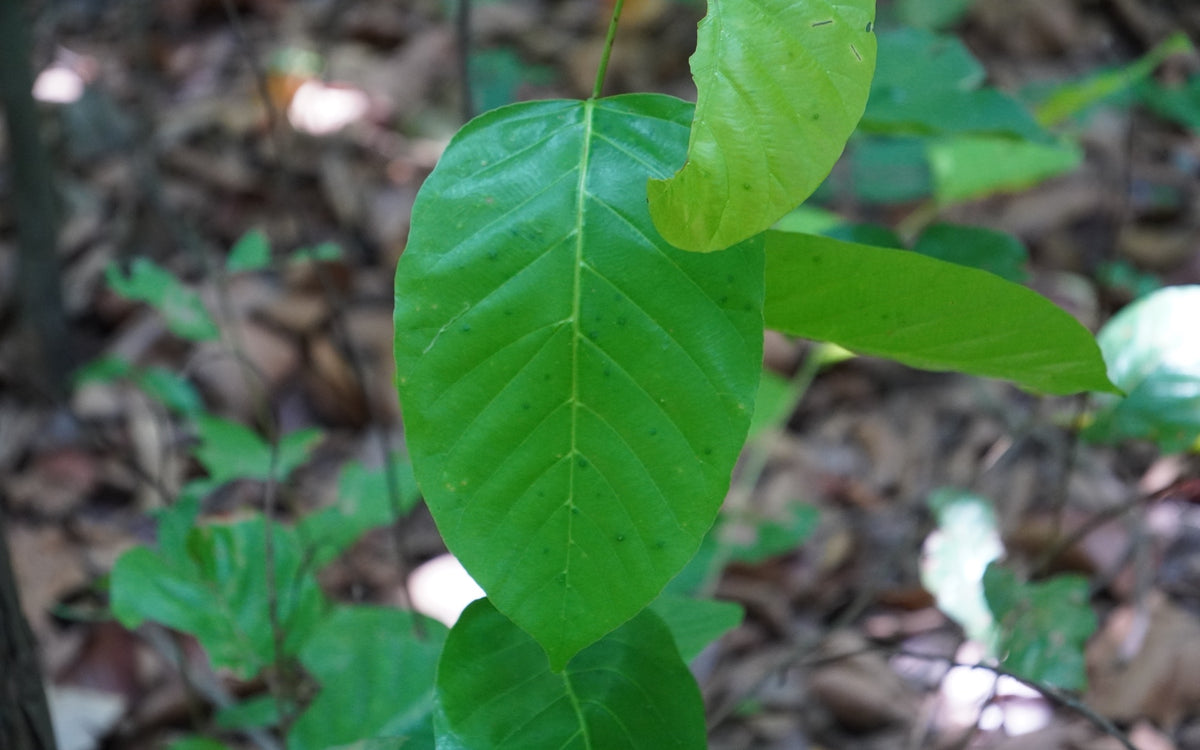
Mitragyna speciosa is a wet-tropical tree, but that description is only the beginning of its cultivation story. Field surveys have documented kratom in humid lowlands, river corridors, household gardens, alluvial soils, and peat. Controlled studies have grown young plants in Florida greenhouses, outdoor containers, hydroponic systems in Thailand, and propagation rooms. Each setting has revealed something useful without producing one universal soil mix, temperature, irrigation schedule, or light prescription.
The leaves matter because people consume kratom. In Southeast Asian records, fresh leaves are chewed or prepared as water-based drinks; elsewhere, dried leaf becomes powder, capsules, tea, and extracts. Kratom alkaloids can produce stimulant-like and opioid-like effects, and reported risks include nausea, dizziness, constipation, sedation, dependence, and withdrawal. Cultivation can influence the plant and its chemistry, but a growing condition does not guarantee a particular human effect. The finished lot still needs its own identity, composition, and contaminant records.
Wet-tropical habitat is the botanical baseline
Royal Botanic Gardens, Kew places M. speciosa primarily in the wet tropical biome. A 2022 taxonomic treatment based on Thai fieldwork and herbarium material recorded the species in tropical lowland evergreen rain forest, often near streams and river banks. The same treatment noted swamp and streamside records in Peninsular Malaysia and natural Thai occurrences from near sea level to about 200 meters.
Those records explain why water, humidity, and lowland conditions recur in cultivation research. They do not establish that every root system should remain submerged or that the tree cannot grow outside that exact setting. Native habitat, a planted farm, a container trial, and a climate-controlled room expose plants to different combinations of soil oxygen, drainage, radiation, wind, pests, and seasonal change. The botanical guide to the kratom tree covers the species, range, and physical features in greater depth.
Alluvial soil and peat are documented, not interchangeable formulas
Kratom cultivation in Kapuas Hulu, West Kalimantan, has been documented on riverbanks and alluvial land. A 2024 soil study also sampled one kratom field on mineral alluvial soil and one on peat. Five subsamples from each field were combined for most analyses. Both sites already supported cultivated trees, and the authors reported physical and chemical properties compatible with growth at those locations.
That survey confirms that kratom can occur in more than one soil class. It was not a randomized comparison of yields across many farms, and two composite field samples cannot define an ideal soil for Indonesia, Thailand, or a greenhouse. Peat and alluvium differ in organic matter, density, porosity, nutrient behavior, drainage, and metal mobility. Even within one named soil class, land history and water movement can vary substantially.
The same study reported the measured heavy metals below the thresholds it applied to those two fields. That finding belongs to those samples. It does not certify every peat or alluvial field, especially where flooding, mining, industry, road dust, irrigation water, or imported amendments could introduce contaminants. Soil history and representative testing remain more informative than a soil name alone.
Water availability helps until stress becomes damaging
Natural kratom populations have been described in freshwater swamp and riverside settings where roots can experience prolonged wetness. Field observations therefore support an affinity for moist environments. They do not answer exactly how much water a young plant, a mature tree, a peat field, and a free-draining container need at every season.
A 2025 controlled study placed 270 six-month-old seedlings in aerated hydroponic boxes at 25–27°C and 60–70% relative humidity. The researchers used polyethylene glycol to create three water-potential treatments while also varying LED light. Mildly reduced water potential was compatible with growth and produced the highest mean mitragynine result in that experiment. The strongest treatment, −0.7 MPa, reduced both growth and mitragynine content.
This is direct evidence that severe drought-like stress can be costly even when moderate stress is tolerated. It is not an irrigation recipe. Polyethylene glycol in an oxygenated hydroponic solution simulates a defined water-potential condition; it does not reproduce a field soil cycling between rain, drainage, evaporation, and groundwater. Root-zone moisture, oxygen, soil texture, container volume, tree size, and weather have to be recorded together.
Young plants and mature trees can respond differently to light
A Florida study compared 60 genetically matched young kratom plants under outdoor full sun, an unshaded greenhouse, and a shaded greenhouse receiving about 25% of full sunlight. Over the study period, both greenhouse groups grew taller and wider than the outdoor group. The shaded-greenhouse plants had the largest average leaves, and greenhouse plants developed more total leaf area than plants in full sun. Mitragynine, paynantheine, and corynoxine concentrations per unit of leaf dry mass were greatest under the shaded treatment.
An observational study of mature trees across four Thai regions found a different association. Among the sampled trees, higher light and greater soil volumetric water content were the strongest measured variables associated with higher mitragynine. The authors explicitly contrasted their mature field trees with the younger, shade-tolerant greenhouse plants and called for controlled work that separates plant stage from environment.
Both findings can be true. A young plant adjusting to a container and a mature canopy rooted in a landscape do not intercept light in the same way. Greenhouse glazing and shade cloth also change light quality, not only intensity. “Full sun” and “shade grown” are therefore incomplete claims unless they include plant age, setting, radiation measurement, duration, and the outcome that was actually measured.
Temperature and humidity evidence is still mostly descriptive
Southern Thailand, where the species occurs naturally, has a warm monsoon climate. One regional field study described long-term mean temperatures around 27.0–28.4°C in southern locations. Controlled seedling work has commonly used similarly warm conditions: the Thai hydroponic experiment maintained 25–27°C, while one Florida greenhouse fertility trial averaged 23.3°C with substantial daily variation and high average relative humidity.
Those numbers show conditions under which the studied plants grew. They are not the result of a temperature-threshold experiment. The Florida radiance trial also continued through months when average greenhouse and field temperatures declined from roughly 28°C in September to about 17–19°C in December, but temperature was not independently assigned as a treatment. That study cannot establish a minimum safe temperature, a cold-hardiness zone, or an ideal day-and-night range.
Humidity has a similar evidence boundary. Mature Thai field data associated higher relative humidity with higher mitragynine within the sampled gradient, yet humidity also changes with temperature and air movement. No single percentage can describe the combined risks of desiccation, leaf wetness, fungal growth, and poor ventilation in every system.
More fertilizer increased biomass without uniformly increasing leaf concentration
A four-month University of Florida experiment assigned 68 cloned trees from one mother plant to four slow-release fertilizer rates. Higher rates increased height, width, trunk diameter, leaf number, total leaf area, and dry leaf mass. Trees in the highest treatment produced about ten times the leaf dry mass of unfertilized controls.
Leaf alkaloid concentration did not rise in one matching line. Fertilizer rate had little overall effect on mitragynine, paynantheine, speciociliatine, mitraphylline, or corynoxine per unit of dry leaf. Mitragynine was quantifiable in only part of the sampled material, and 7-hydroxymitragynine remained below the method’s lower limit of quantification throughout the experiment. Low or medium rates produced the highest concentrations of several other measured alkaloids, while total alkaloid mass per plant rose largely because the fertilized trees produced much more leaf biomass.
This distinction matters: concentration in a gram of leaf and total compound recovered from a whole tree are different outcomes. The study supports responsive nutrient management for growth. It does not justify copying its container size, branded substrate, fertilizer product, or application rates into a field with different genetics, soil reserves, rainfall, and production goals.
Calcium and magnesium research is promising but early
Thai field surveys have repeatedly identified soil calcium, magnesium, pH, and water content as variables worth studying. A 2026 controlled experiment took the next step by applying calcium and magnesium treatments to seedlings from one seed stock for 45 days. Untreated controls had the greatest total biomass, while some moderate nutrient-balance treatments produced mitragynine values about 2–14% above the control.
That tradeoff is more useful than a headline claiming one “best” mineral ratio. The experiment was short, used a standardized soil mixture and young plants, and included only a preliminary one-month field observation. Its results do not establish a permanent amendment target for mature trees or justify adding minerals without a soil test. Excess nutrients, antagonism between elements, salinity, local pH, and runoff all remain site-specific concerns.
Successful propagation is only the establishment stage
A rooted cutting or germinated seedling has crossed an important threshold, but it has not demonstrated long-term field performance. A 2025 propagation study reported 85–92% rooting in indoor aeroponic treatments, while seasonal greenhouse-mist results ranged from about 7% to 98%. Photoperiod, cultivar, rooting system, season, and hormone treatment affected different measurements. The breadth of the greenhouse range is evidence that establishment conditions matter.
Those experiments end before a tree experiences years of soil, weather, pruning, pests, and harvest. Seed and cutting biology belongs in How Kratom Trees Reproduce; cultivation begins after that biological pathway is identified. A nursery record should follow the plant into the field rather than being treated as proof of mature yield or chemistry.
Field surveys and controlled experiments answer different questions
Field research shows where real trees have survived and how traits vary across lived landscapes. It captures weather, soil, age, management, and genetics together, which makes it realistic but difficult to separate cause from correlation. Controlled experiments assign one or several factors under a defined protocol, making causal comparisons stronger while narrowing the material and setting.
- Habitat records establish documented occurrence, not an optimal farm design.
- Field surveys reveal associations among sites, not guaranteed responses to one isolated variable.
- Container and greenhouse trials compare assigned treatments, but roots and canopies remain constrained by the system.
- Hydroponic trials control nutrient solution and water potential, but do not reproduce soil structure or field drainage.
- Propagation trials measure early establishment, not mature-tree performance.
A credible cultivation claim identifies which kind of evidence supports it.
A useful agronomy record follows the actual site
Study-bounded cultivation starts with measurement rather than a copied formula. The most useful record connects:
- authenticated species identity and the seed or parent-plant source;
- plant age, propagation pathway, transplant date, and survival;
- site coordinates, elevation, slope, prior land use, and neighboring activities;
- soil texture, organic matter, pH, salinity, nutrients, water-holding behavior, and relevant contaminants;
- rainfall, root-zone moisture, irrigation events, drainage, flooding, temperature, humidity, and wind;
- measured light exposure, canopy position, shade structure, and plant stage;
- fertilizer or amendment identity, amount, timing, and the result of follow-up testing;
- pests, disease, leaf damage, harvest date, leaf position, and postharvest handoff; and
- the lot code linking harvested material to representative analytical results.
World Health Organization guidance for medicinal plants follows the same basic principle: document the species, site, soil, inputs, water, harvest, personnel, and handling rather than relying on a crop name alone.
What cultivation language cannot establish
- “Tropical grown” does not identify a farm, microclimate, harvest, or lot.
- “Riverbank,” “alluvial,” or “peat grown” does not guarantee clean soil or superior chemistry.
- “Shade grown” and “full sun” do not have one meaning across seedlings, mature trees, greenhouses, and field canopies.
- More fertilizer does not guarantee a greater concentration of mitragynine in each gram of leaf.
- Water-loving habitat does not mean severe flooding or severe drought is harmless.
- A successful cutting, seedling, or short trial does not predict years of field performance.
- No cultivation adjective guarantees stronger effects, safety, purity, or freedom from contaminants.
The wild-harvested versus cultivated guide separates production-system claims from quality assumptions. The sustainability and conservation guide covers land history, harvest pressure, processing, packaging, and freight evidence.
Questions that make a cultivation claim verifiable
- Was the evidence collected from seedlings, mature trees, a greenhouse, hydroponics, or a working field?
- How many plants and sites were studied, for how long, and were treatments assigned?
- Were genetics, tree age, leaf position, season, and postharvest handling held constant?
- Were light, water, temperature, humidity, soil nutrients, and contaminants measured or merely described?
- Was the reported outcome survival, biomass, leaf area, concentration per gram, or total yield per plant?
- Can the cultivation record be connected to the harvested lot and its laboratory result?
For the next part of the plant record, see Kratom Chemistry Across the Growing Cycle. It examines leaf development, season, tissue, genetics, harvest, and postharvest change without turning any one variable into a potency promise.
Sources and further reading
- National Institute on Drug Abuse: Kratom effects and research overview
- Royal Botanic Gardens, Kew: Mitragyna speciosa
- Ngernsaengsaruay et al. (2022): Thai Mitragyna taxonomy, habitat, and morphology
- World Health Organization: Good agricultural and collection practices for medicinal plants
- Suryadi, Indrawati, and Junaidi (2024): Alluvial and peat soils under kratom cultivation in Kapuas Hulu
- Zhang et al. (2020): Nutrient fertility, growth, and leaf alkaloids
- Zhang et al. (2022): Kratom growth and alkaloids under varying radiance
- Leksungnoen et al. (2022): Environment and mitragynine in mature Thai trees
- Chongdi et al. (2025): Regional growth and leaf traits in Thailand
- Leksungnoen et al. (2025): Light, water potential, growth, and alkaloids in hydroponic seedlings
- Zhang et al. (2025): Aeroponic and greenhouse-mist cutting establishment
- Leksungnoen et al. (2026): Calcium-magnesium treatments, seedling growth, and mitragynine
For botanical and cultivation-science education only; not a growing guarantee, a medical recommendation, or evidence that any cultivation method produces a particular human effect.
Image credit: “Kratom (Mitragyna speciosa) plant leaf at Purbachal” by Ishtiak Abdullah, CC BY-SA 4.0; cropped from the original.