
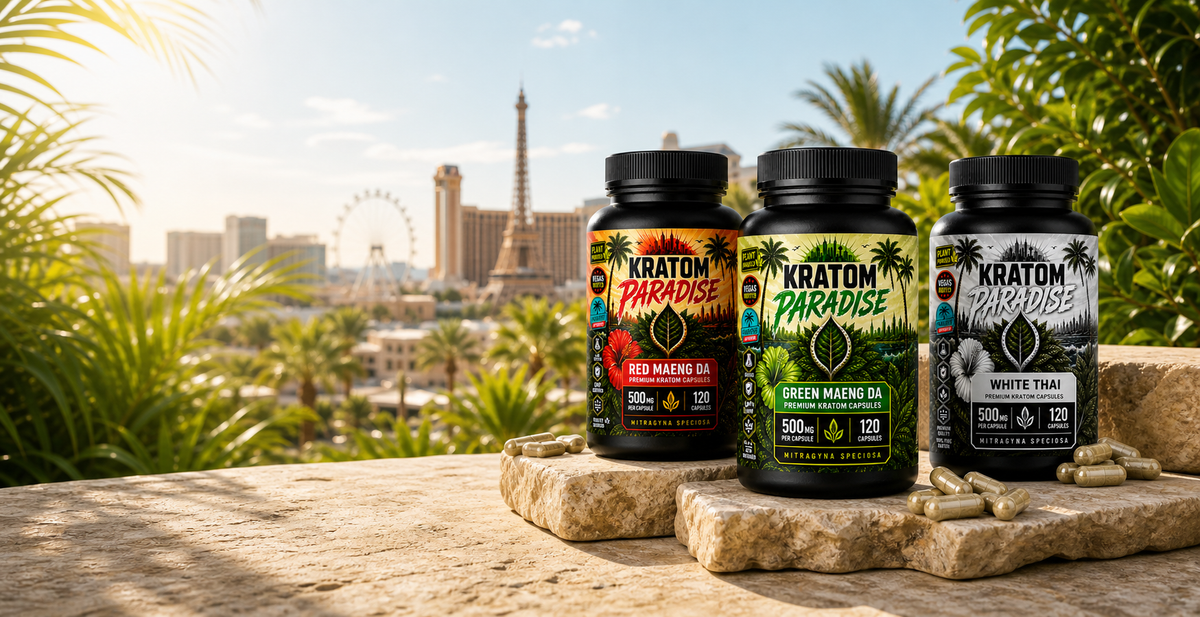
Three labeled Kratom Paradise powder pouches beside loose botanical powder in a bright Las Vegas scene

How to Read a Kratom Product Label: Weight, Count, MIT, and Batch Fields
Prepared and maintained by the Kratom Paradise Editorial Team. Last editorial review: July 13, 2026. Read our editorial standards and sourcing policy.

A kratom label can place several numbers beside one another: pouch weight, capsule fill, capsule count, MIT strength, extract concentration, flavor, container size, and batch information. Those fields answer different questions. Reading them correctly starts by identifying the product format before comparing any number.

This guide uses current Kratom Paradise examples to show how the fields fit together. It does not provide serving, dosing, effect, conversion, or medical guidance. The goal is simpler: match the product name, selected option, physical package, cart line, and available document without treating unlike measurements as equivalents.

Start with identity, not the largest number

Read the product title first. A botanical powder, a bottle of leaf-filled capsules, an MIT-labeled chewable tablet, and an MIT extract powder belong to separate product lanes. A number printed on one format may describe something entirely different from a number on another.

  • Product family: botanical powder, botanical capsules, MIT chewable tablets, or MIT extract powder.
  • Catalog name: the strain-family or product-line name used to identify the item.
  • Selected option: weight, count, labeled strength, flavor, or container size chosen on the product page.
  • Traceability fields: batch, lot, or other identifiers available on the unit or related document.

The Kratom Product Types Explained guide is the best starting point when the format itself is unclear. Once the format is identified, the remaining fields become much easier to read.

Kratom powder: product name plus net weight

Botanical kratom powder is packaged by weight. A label such as Green Maeng Da Kratom Powder identifies the catalog family and format; a selection such as 250g, 500g, 1kg, or 5kg identifies how much powder is in the chosen pouch. The strain-family name does not replace the net-weight field, and the pouch weight does not describe a concentration or an alkaloid result.

When comparing two powder products, confirm both the catalog name and the selected pouch size. Similar packaging colors can make a quick visual check unreliable. The product title on the page, the size selector, the cart line, and the label on the delivered pouch should describe the same item.

Current sizes and the distinction between catalog names and product claims are explained in the Kratom Powder Guide. The full botanical powder catalog appears in the Kratom Powder collection.

Kratom capsules: capsule fill, bottle count, and net weight

A capsule label needs more than one quantity because the package contains many individual capsules. Kratom Paradise botanical capsules currently use 500mg capsule-fill information. That figure describes the listed amount of leaf powder in each capsule. It is not the number of capsules in the bottle and it is not an MIT strength label.

Bottle count answers a separate question. Standard products currently use 120, 250, 500, and 1,000-count options, with a corresponding net-weight relationship shown in the selector. For example, a selection may display both the count and the total weight associated with that count. Read the complete selector rather than pulling one number away from its label.

Bulk capsules use the same basic logic at larger counts: product family, 500mg capsule-fill information, and the selected bottle or order count. The word bulk identifies the larger catalog lane. It does not by itself establish wholesale terms, resale authorization, inventory guarantees, or a specific discount.

Use the Kratom Capsules Guide and the Kratom Capsules collection to compare current standard-count options without mixing them with MIT tablets.

MIT chewable tablets: labeled strength, flavor, and quantity

MIT chewable tablets use a three-part selector: labeled MIT strength, flavor, and tablet quantity. The current standard product lists 100mg MIT and 200mg MIT options, four flavors, and quantities of 5, 10, 25, or 50 tablets. All three selections belong together.

The strength field is part of that specific tablet label. It should not be read as a botanical capsule-fill weight, an extract percentage, a serving recommendation, or a conversion into another product format. Flavor identifies the selected flavor, and quantity identifies the number of tablets in the package. Neither changes what the other fields mean.

The letters MIT are commonly used as shorthand for mitragynine. The National Center for Complementary and Integrative Health identifies mitragynine as one of the compounds found in kratom. A commercial MIT field still needs its surrounding product title and unit; the abbreviation alone is not a complete label.

For the store's terminology, read What Does MIT Mean in Kratom Products? or browse the MIT Chewable Tablets collection.

MIT extract powder: product line, flavor, and container size

MIT extract powders use another label system. Current Kratom Paradise standard listings are organized as a 60% mitragynine line and a separate 90% MIT-CH line. Each then adds a flavor and a container-size selection. The standard sizes are 0.5g, 1g, 2g, and 5g. Bulk listings begin at 10g and extend through larger sizes.

A percentage in the product-line title and a gram value in the size selector do not describe the same property. The product line identifies the labeled extract category; the gram selection identifies the amount in the chosen container. Flavor is another independent selector. Read the complete product title and all selected options together.

Do not convert an extract percentage into a tablet strength, botanical powder weight, capsule count, or expected outcome. Those comparisons require assumptions this guide does not make. The clearest comparison stays within one format and checks the product line, flavor, size, cart entry, and available product document as a set.

The MIT Extract Powder collection keeps standard extract listings together, while the broader MIT Products collection maps the separate tablet and extract lanes.

Batch, lot, and laboratory-document fields

Product identity continues beyond the front label. A batch or lot identifier helps connect a physical unit with manufacturing and testing records. A laboratory report may show a sample name, report or sample number, received date, completed date, method, measured analytes, units, and results. The exact fields vary by laboratory and test panel.

A COA should be read as a report about the sample identified in that document. It does not automatically cover every product with a similar name, every lot sold before or after it, or every testing category a customer might expect. Match the product name and any available batch or lot information before interpreting the table of results.

Our How to Read a Kratom Lab Report or COA guide explains sample identity, dates, units, methods, and reported testing categories in more detail. The Product Quality and Lab Testing page describes how those documents fit into the wider quality process.

What a label does not establish

A label identifies and describes a product; it does not turn the product into an approved medical treatment or guarantee an individual result. The U.S. Food and Drug Administration states that there are no approved prescription or over-the-counter drug products containing kratom or its known alkaloids and continues to warn consumers about kratom. Readers should not interpret catalog language as FDA approval or medical guidance.

Likewise, familiar red, green, white, yellow, gold, geography-style, and Maeng Da names organize marketplace catalogs. They are not laboratory results and should not be treated as guaranteed outcomes. The same principle applies to package color: it can help identify a product family, but it does not replace the written title, selected option, batch details, or document.

A practical label-check sequence

  • Read the full product title and identify the format.
  • Confirm the strain-family or product-line name.
  • Read every selected option with its unit: weight, count, labeled strength, flavor, or size.
  • Compare the product-page selection with the cart line before checkout.
  • Keep the delivered product in its original labeled package.
  • Match batch or lot details to the available laboratory document when those fields are provided.
  • Do not convert unlike label fields into serving, effect, or equivalency claims.

This sequence prevents most label-reading errors because it keeps each number attached to the field it describes. It is also useful when storing several products: an intact label preserves the product identity, selected size or count, and any traceability information that would be lost in an unmarked container.

For storage practices, continue with How to Store Kratom. For the principles behind restrained product wording, read How Responsible Kratom Brands Label Products in 2026.

Sources and further reading

This material is provided for general product-label education. It is not medical, dosing, serving, or legal advice.

Written By : Kratom Paradise Editorial Team