Kratom Packaging History: From Fresh Leaf to Pouches, Bottles, and Lot Codes
Historical and market records reviewed: July 15, 2026. Packaging practices and legal requirements vary by product and jurisdiction; current rules should be confirmed before a commercial or legal decision.
Kratom packaging changed because the product changed. Fresh Mitragyna speciosa leaves can be chewed soon after harvest, and water-based leaf preparations can be made and consumed within a community. Dried leaf can travel. Powder can be divided into hundreds of similar-looking packages. Capsules, tablets, gummies, liquids, and extracts add unit counts, ingredients, concentrations, and closures that a loose leaf never needed.
People consume those forms for effects including alertness, energy, reduced fatigue, relaxation, pain relief, and managing withdrawal. They can also experience nausea, dizziness, constipation, sweating, sedation, dependence, withdrawal, interactions, and other adverse effects. Once a product is separated from the tree, maker, and person who prepared it, the package carries more of the burden of identity. Its barrier, label, seal, lot code, and linked laboratory record perform different parts of that job.
Fresh local leaf needed little commercial packaging
Southern Thai studies describe people chewing fresh leaves, sometimes as a daily work practice. Northern Malaysian records describe drinking ketum decoctions. In those settings, the person consuming kratom could know the tree, grower, preparer, or household source directly. Freshness and recognizable leaf form supplied context that a printed retail panel now has to recreate.
That older pattern should not be romanticized as risk-free. Fresh-leaf consumers reported intoxication, dependence, and withdrawal as well as valued effects. The point is narrower: a recognizable leaf obtained locally does not need a pouch to tell someone that it is a leaf. The history of kratom before ecommerce follows that human and commercial transition in full.
Drying turned a short-lived leaf into a transportable material
Fresh plant material contains substantial water. Drying reduces moisture, makes leaves easier to store and mill, and allows them to move farther from harvest. It also creates new questions: how dry was the material, what touched it, what lot does it belong to, and did humidity enter during storage or transit?
Packaging at this stage is primarily a physical control. A closed bag, sack, liner, drum, or carton can reduce ordinary exposure to dirt, rain, humidity, pests, and mixed cargo. It cannot repair contaminated handling or prove species identity. The physical steps from harvest through drying and milling are owned by the leaf-to-powder processing guide.
Bulk sacks and liners came before the retail pouch
Bulk botanical trade favors containers sized for handlers and processors rather than individual consumers. Paper or kraft sacks, woven or plastic bags, cartons, and inner liners can hold crushed leaf or powder during aggregation and export. A current supplier listing on Indonesia’s Ministry of Trade portal, for example, describes bulk kraft bags with inner liners. The listing documents one modern market offer; it is not a universal government packaging specification.
The distinction between shipping container and consumer package is longstanding in general weights-and-measures practice. NIST’s model Uniform Packaging and Labeling Regulation treats bulk transport wrapping differently from a package sold to an end customer. A 25-kilogram lined sack therefore serves a different communication role from a 100-gram retail pouch even when both hold material from the same parent lot.
Milling made product identity less visible
A whole leaf retains visible botanical features. Fine green-brown powder does not. Once leaves are milled, unrelated species, different batches, ordinary leaf, enhanced powder, and extract powder can look superficially similar. Powder packaging therefore has to preserve a name, net amount, business identity, and lot relationship that the eye cannot recover from the contents alone.
That shift also helped marketplace color and geography terms move to the front panel. Red, green, white, Bali, Borneo, Thai, Malay, Maeng Da, and similar names organize retail catalogs, but they do not prove a botanical subspecies, origin, chemistry, or effect. The kratom strain-name guide separates those catalog families from testable product facts.
Heat-sealed pouches became a documented retail form
By 2018, FDA recall records documented kratom powders sold online in plastic heat-sealed pouches at 28-, 56-, and 112-gram sizes. The front-facing retail package combined a brand, product name, net weight, and a lot code representing a packaging date. A barrier pouch could be filled and sealed efficiently while providing a large printable surface for many variants.
Modern stand-up pouches often add a zipper inside the heat seal. The original seal closes the package before first opening; the zipper allows repeated closure afterward. Material structure varies. An opaque multilayer pouch can be designed to limit moisture, light, air exchange, and odor transfer more effectively than thin single-layer film, but appearance alone cannot reveal its barrier specification or seal quality.
Bottles and jars followed capsules, tablets, and liquids
Capsules changed the amount consumers saw from a loose powder weight to a container holding many units. FDA’s 2018 kratom investigation described a 300-capsule jar, a bottle of powdered kratom, and 90 unlabeled black plastic bottles containing unidentified-brand powder. Those examples show both sides of packaging: a container can organize individual units, while a container without identity creates a traceability failure.
Bottles also suit tablets, gummies, and liquids because they can use screw caps, dropper or measured closures, induction liners, shrink bands, and breakaway features. The container does not make the formats equivalent. A bottle of leaf capsules, a bottle of concentrated liquid, and a bottle of tablets require different quantity and composition information. Current format distinctions belong in the Kratom Product Types guide.
Extracts created new label systems
A pouch of ordinary milled leaf can be described by ingredient identity and net weight. Extracts add a manufacturing step that concentrates selected constituents, and finished products may report ratios, percentages, milligrams per unit, milligrams per container, or liquid concentrations. Research on commercial kratom products has found wide chemical variation, and analyses of products marketed around 7-hydroxymitragynine have found discrepancies between package claims and measured contents.
This is why the modern package cannot rely on words such as extract, premium, full-spectrum, enhanced, or extra strength. The product identity, named constituent, unit, basis, ingredient statement, package quantity, and lot-specific record have to remain connected. The current product-label guide owns the field-by-field reading process rather than repeating it here.
A seal shows closure history, not chemical quality
Heat seals, induction liners, shrink bands, breakaway caps, and tear strips can provide evidence that a closure has been disturbed. They also help maintain the intended package barrier during distribution. Their value is physical and visible.
A pristine seal does not establish botanical identity, alkaloid concentration, microbial status, heavy-metal results, or lawful labeling. An incorrect product can be sealed perfectly. A properly tested product can also be damaged after a closure fails. Modern packaging works best when closure controls, manufacturing records, laboratory records, and the printed identity agree.
Lot codes made recalls more precise
The 2018 PDX Aromatics recall shows why a short printed code became one of the most consequential additions to a kratom package. The notice named products, net weights, shipment windows, and specific lot codes. Customers could compare the code on a heat-sealed pouch with the recall record rather than discard every product the companies had ever sold.
A lot code is only the visible end of a longer system. Internal records must connect the code to packaging dates, source material, testing, distribution, and any later split or relabeling. The batch, lot, and laboratory-sample-ID guide follows those relationships without turning the packaging history into a code-reading tutorial.
The 2018 Salmonella outbreak made packaging a public-health record
FDA’s mandatory recall involved powdered and encapsulated kratom products linked to Salmonella findings. The agency’s product photos, sample identifiers, brand names, package forms, lot records, and distribution information became part of the investigation. FDA also advised that kratom removed from original packaging should be discarded during that event because the product identity could no longer be checked against the recall.
The lesson extends beyond one outbreak. A package is not merely advertising around a consumable product. When contamination, a label error, or a product complaint occurs, the original container can preserve the exact identity needed to narrow the response. Laboratory testing and the heavy-metals and microbial-testing guide answer what was measured; packaging and distribution records answer which units may be involved.
Barcodes helped commerce; batch codes helped traceability
A Universal Product Code identifies a commercial item or configuration for inventory and checkout. Many packages of the same size and product can share that code. A batch or lot code distinguishes a defined production or packaging group. A laboratory sample ID identifies the portion received by a laboratory. These identifiers may appear near one another while answering different questions.
Digital commerce added order numbers, inventory SKUs, fulfillment records, and carrier tracking. Those records can reconstruct who received a particular lot when they are mapped correctly. They can also create false confidence if a stable SKU is mistaken for a changing batch. The farm-to-shelf traceability guide owns the complete record chain.
COAs moved from supplier paperwork to customer access
A certificate of analysis was historically more likely to travel between a laboratory, importer, manufacturer, or buyer as business documentation. Online retail made it possible to place the complete PDF in a public document center or connect a package to a lot-specific record through a short URL or QR code.
Public access improves transparency only when the document matches the product. A composition report for bulk extract powder may support tablets made from that ingredient when manufacturing records document the ingredient lot and subsequent formulation. It does not automatically report tablet weight, added flavors or binders, every finished-product contaminant result, or every future batch. The COA guide covers sample identity, dates, methods, units, detection limits, and scope.
Manufacturing systems connected packaging to records
General dietary-supplement current good manufacturing practice under 21 CFR part 111 illustrates the mature record architecture behind modern botanical packaging. FDA’s small-entity guide describes packaging specifications, representative labels, batch production records, unique packaging and label identifiers, label reconciliation, lot assignments, quality-control release, reserve samples, and distribution traceability.
Those rules do not settle kratom’s federal product category. FDA’s current kratom page states that kratom is not lawfully marketed in the United States as a drug product or dietary supplement and cannot lawfully be added to conventional food. Part 111 remains relevant to packaging history as an example of the systems that botanical manufacturers and private standards programs have used as a quality benchmark; following a benchmark is not FDA approval or proof of lawful marketing.
State kratom rules added a product-specific layer
Some states now impose kratom-specific registration, age, composition, warning, label, or package requirements. Rhode Island’s 2026 state guidance, for example, summarizes product-form restrictions, alkaloid declarations, warnings, net quantity, business information, and child-resistant packaging requirements.
These frameworks differ and can change. A package sold in one state is not a national legal template. The product-type and kratom-law guide explains why plant material, conventional food, dietary-supplement claims, drugs, extracts, and controlled compounds can trigger different questions.
Modern packaging has four separate layers
- Barrier: the pouch, bottle, liner, cap, or seal limits environmental exposure and ordinary handling.
- Identity: the printed panel names the product, format, ingredients, quantity, responsible business, and other applicable information.
- Traceability: a lot, batch, date, SKU, or distribution record connects the individual package to a defined material and event.
- Evidence: a laboratory report or quality record describes the identified sample and tests performed.
Each layer can fail while the others appear intact. A strong barrier can carry an incorrect label. A correct label can lack a usable lot connection. A matching lot can have no relevant contaminant panel. A complete COA can describe a different sample. Treating the four layers separately makes the package more informative without asking one feature to prove everything.
Packaging history is the history of increasing distance
The journey from fresh leaf to modern pouch is a journey away from immediate context. The consumer may no longer know the tree, farmer, processor, importer, laboratory, or person who filled the container. Packaging evolved to carry fragments of that missing context across distance: a physical barrier, an ingredient identity, a net amount, a business name, a lot code, and a route to supporting records.
That evolution also created more room for visual branding, vague strength language, and copied origin stories. A polished pouch is not evidence of quality by itself. The most useful modern package is the one whose identity can be followed backward into records and whose product form can be understood without guessing. The local-leaf-to-global-commodity history follows the wider trade and ecommerce transition. For storage after opening, continue with How to Store Kratom; for the wider quality system, use Product Quality & Lab Testing.
Sources and further reading
- Saingam et al. (2023): long-term fresh-leaf consumption in southern Thailand
- Vicknasingam et al. (2010): informal ketum use in northern Peninsular Malaysia
- WHO ECDD: 2021 kratom, mitragynine, and 7-hydroxymitragynine pre-review
- INAEXPORT supplier listing: bulk kraft bags and inner liners as a current market example
- U.S. DEA: kratom product forms and human-effects summary
- U.S. FDA: 2018 recall of heat-sealed kratom powder pouches by product and lot
- U.S. FDA: 2018 recall letter documenting jars, bottles, samples, and unlabeled containers
- U.S. FDA: mandatory recall and original-package guidance
- Lydecker et al. (2016): analysis of commercial products and suspected 7-OH adulteration
- Todd et al. (2020): chemical variability across more than 50 commercial kratom products
- Hill et al. (2023): variability in information supplied by GMP-qualified vendor websites
- Brown et al. (2026): package claims and measured 7-hydroxymitragynine in commercial products
- U.S. FDA: packaging, labeling, batch, and distribution records under 21 CFR part 111
- U.S. FDA: current federal position on kratom products
- NIST Handbook 130 (2026): model Uniform Packaging and Labeling Regulation
- Rhode Island Department of Health: 2026 kratom label and packaging guidance
For historical, packaging, and product-literacy education only. It is not medical, manufacturing, or legal advice.
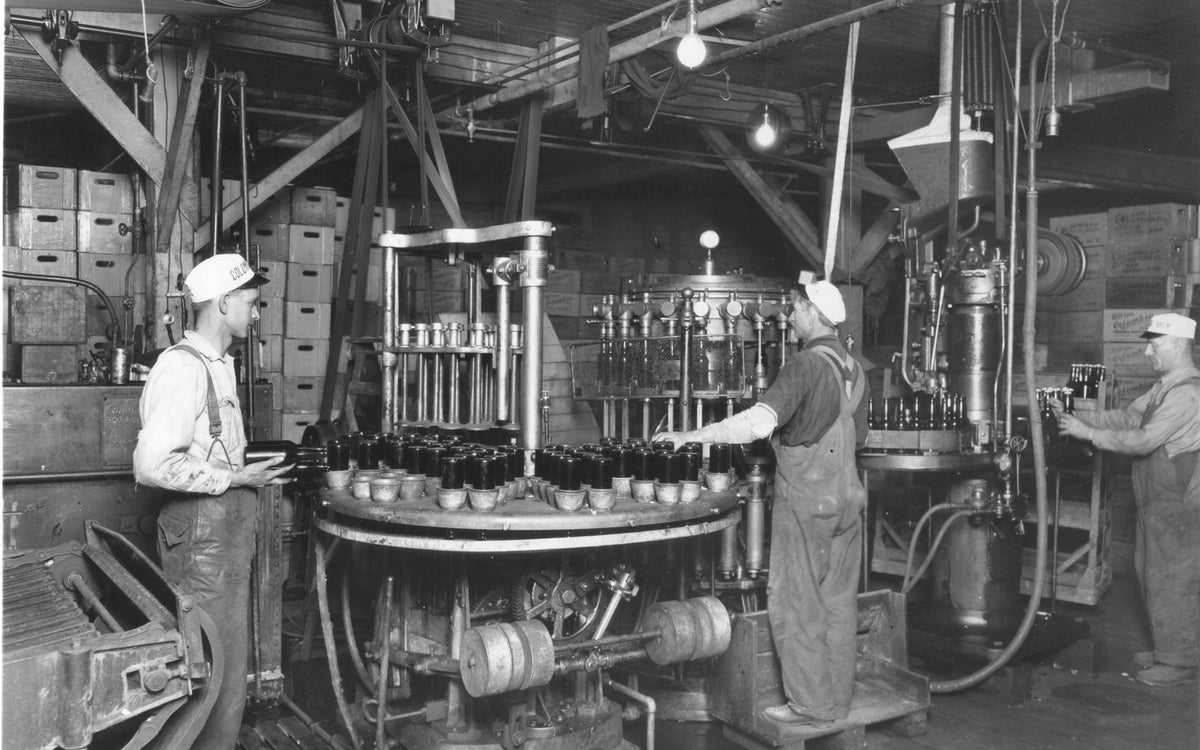
Image credit: 1919 Columbia Brewing Co. bottle machine, Marvin Dement Boland Collection, public domain; cropped from the original.