Kratom & kava guides
Mitragynine Salt Extract Powder: Form, Label, and COA Guide
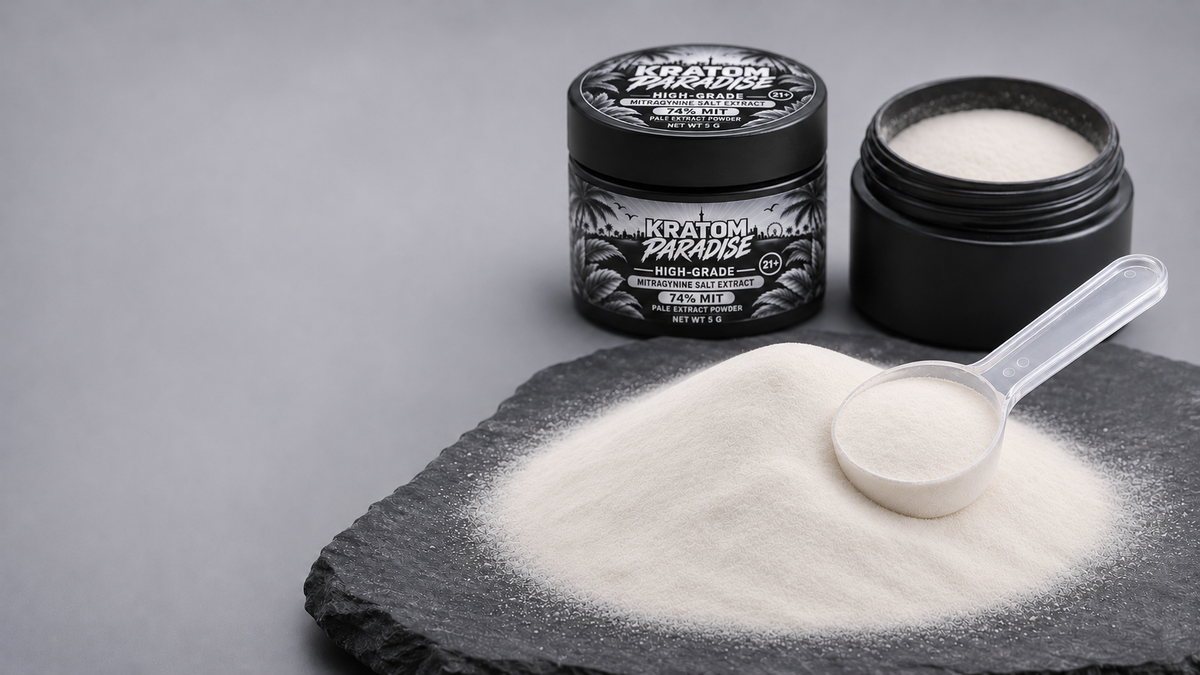
Mitragynine salt extract powder is one of the less common formats in the kratom extract category. Its pale appearance, concentrated alkaloid profile, and salt-form positioning set it apart visually from the darker amber or brown freebase extracts shoppers may know—but the word “salt” is only one part of the product identity.
The Kratom Paradise high-grade pale extract is organized around three verifiable facts: the physical form is a loose pale powder, the current batch report lists 73.9938% mitragynine by weight, and the product belongs on its own page with its own documentation rather than under the existing 90% freebase extract listing.
What does “mitragynine salt” mean?
In chemistry, a salt form is an ionized pairing of a basic or acidic compound with a counterion. It is not a reference to table salt, and it does not mean the powder should look or taste like sodium chloride.
Mitragynine is a weakly basic alkaloid. Published physicochemical research reports that mitragynine becomes more ionized under lower-pH conditions and that measured aqueous solubility varies sharply with pH. That helps explain why chemists pay attention to form and formulation. It does not mean that every product described as a salt behaves identically in every liquid or that salt form alone proves a particular absorption rate, onset, or effect.
The responsible way to read the product is straightforward: identify the physical form, then review the measured batch profile and complete label. Do not substitute a general claim about salt chemistry for product-specific evidence.
An uncommon but established extract format
Most extract-powder listings emphasize a concentration percentage without clearly naming whether the material is a freebase or salt form. Salt extracts occupy a much smaller part of the market, with a limited number of products positioned around the mid-60% through upper-70% MIT range. Kratom Paradise gives the form, measured concentration, pale appearance, and supporting record their own clear product identity.
What makes the Kratom Paradise product noteworthy is the combination of:
- a distinctly pale, near-white powder appearance;
- a current report listing 73.9938% mitragynine by weight;
- a total-major-alkaloids result of 76.5607% for the referenced sample;
- a dedicated salt-form product page rather than a generic extract bucket; and
- clear separation from the darker, higher-percentage freebase extract already in the MIT collection.
The result is a distinctive addition to the MIT collection: uncommon in format, specific in presentation, and easy to compare on documented facts.
74% MIT describes concentration, not product quality by itself
The current batch result rounds from 73.9938% to 74% mitragynine by weight. Percentage by weight answers a specific question: how much of the tested sample’s mass was measured as mitragynine under the laboratory method.
It does not answer every other question about a product. A higher number is not automatically a better format, and a salt-form product does not have to test higher than a freebase extract to be distinct. Refinement, retained minor alkaloids, appearance, texture, documentation, packaging, and intended comparison basis are separate fields.
For that reason, Kratom Paradise keeps the existing 90% product and the new 74% salt-form product on separate listings. They are different materials with different measured profiles—not interchangeable names for the same powder.
Why does the powder look pale?
The referenced sample appears pale cream to near-white rather than green, amber, or dark brown. Appearance can reflect processing and composition, but color alone does not certify identity or concentration. Photography should show the actual pale material without pushing it into an artificial bright white or adding a yellow cast.
Use the physical description together with the product label and report. Never use color as a substitute for batch identification.
Salt form vs. freebase extract
“Salt” and “freebase” describe chemical form. “74%” and “90%” describe labeled or measured concentration on a mass basis. Those are different axes.
| Field | 74% MIT salt extract | 90% MIT freebase extract |
|---|---|---|
| Physical format | Loose pale powder | Loose darker extract powder |
| Form descriptor | Salt-form positioning | Freebase extract positioning |
| Current measured MIT | 73.9938% for the referenced batch | Use the report tied to the current freebase batch |
| Customer comparison unit | Price per gram | Price per gram |
Do not convert either powder percentage into a tablet count or a serving recommendation. For a format-level overview, read Kratom Extract Types & Formats and MIT Tablets vs. MIT Extract Powder.
How to read the salt extract COA
Start with the identity block. Confirm the sample name, sample code, batch or lot code, report date, and matrix. Then move to the results:
- Mitragynine: the main percentage-by-weight result for the referenced sample.
- Total major alkaloids: the sum reported under the laboratory’s stated panel and method.
- Minor alkaloids: individually listed compounds and their units.
- Detection language: distinguish a numeric result, below the limit of quantitation, and not detected.
- Contaminant panels: read the result, reporting limit, and any laboratory status field together.
A report that lists an action limit or status as “N/A” should not be paraphrased as “passed.” The measured values can be reported accurately without inventing a compliance conclusion the laboratory did not issue.
Visit the MIT Product Documents & COA Center for the current product-specific record.
Available sizes
The retail salt-extract page is organized by net weight:
- 2g
- 5g
- 10g
- 25g
- 50g
Net weight describes the amount of powder in the selected package. Compare total price and price per gram within the same product. Do not interpret package size as a direction for use.
Storage and handling
Keep the product in its original labeled container, tightly closed, dry, and away from direct light, excess heat, humidity, children, and pets. Preserving the original label also keeps the product name, net weight, and lot identity connected to the correct documentation.
Frequently asked questions
Is mitragynine salt the same as table salt?
No. “Salt” is a chemical-form descriptor. It does not mean sodium chloride.
Is 74% salt extract stronger than 90% freebase extract?
Not by percentage by weight. The current salt sample measured 73.9938% mitragynine, while the separate freebase line uses its own product-specific report. Form and concentration are different attributes, and a higher percentage should not be turned into an effect claim.
Is the powder pure white?
The referenced material is pale cream to near-white. Product photography should preserve that subtle appearance rather than forcing the powder to look bright white or yellow.
Does salt form prove faster absorption or better effects?
No. Salt form alone does not establish a customer outcome. Product pages should not promise onset, absorption, or effects without direct evidence for the finished product.
Where is the batch report?
Use the report linked on the product page or the MIT Product Documents & COA Center. Match the sample or lot identity before relying on the result.
Compare Kratom Paradise MIT extracts
The new salt-form listing makes an uncommon material easier to evaluate: a pale powder, a 74% MIT product-line designation grounded in the referenced sample result, five net-weight options, and product-specific documentation.
Browse all MIT products · Visit the MIT Product Documents & COA Center
Sources and further reading
For adults 21 and over. Availability and shipping eligibility depend on the destination and current product-specific rules. Kratom products are not intended to diagnose, treat, cure, or prevent any disease.