
Kratom & kava guides
Kratom in Colonial-Era Records: Botany, Museums, and Early Regulation
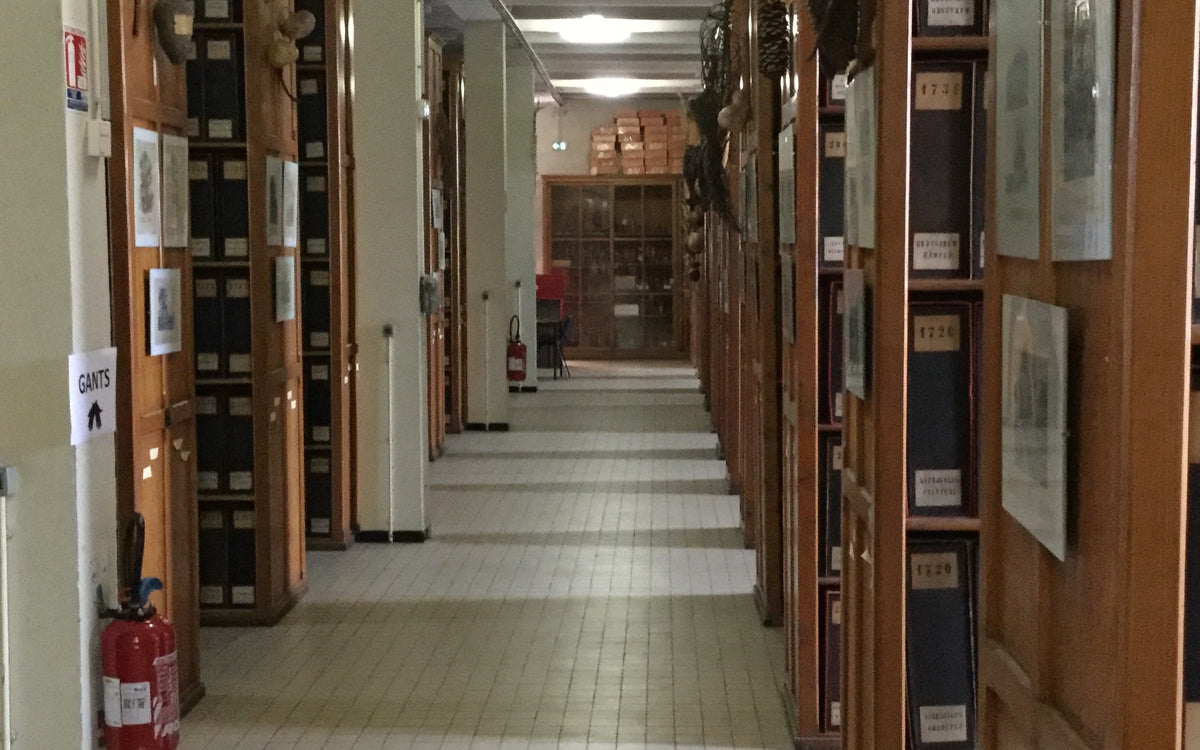
Colonial officials did not discover kratom in the sense of finding an unknown plant. People in Southeast Asia already knew the tree, named it in local languages, cultivated or preserved it near settlements, and consumed its leaves. What European institutions created was a different kind of record: Latin names, pressed specimens, botanical plates, museum accessions, short administrative reports, and later legal categories.
Those records matter because they preserve dates, places, plant descriptions, and some early observations of human use. They are also incomplete. A herbarium sheet can document where a specimen was collected without recording who guided the collector. A museum report can describe people drinking a leaf preparation while giving the official observer far more space than the people whose practice supplied the information. Reading the archive well means using what it actually contains without treating its silences as proof that nothing happened.
The written record begins in the middle of the story
Mitragyna speciosa is native across a broad wet-tropical range that includes Borneo, Sumatra, Malaya, Thailand, Myanmar, Vietnam, Cambodia, the Philippines, and New Guinea. Local names such as krathom in Thailand and biak or ketum in Malaya belong to the regional history of the plant. The earliest surviving European botanical publication is therefore not the beginning of kratom knowledge. It is the point at which one colonial scientific system began filing that knowledge under its own rules.
This distinction is essential. European botanical nomenclature was designed to make specimens comparable across institutions. It did not preserve every local name, preparation, social setting, or reason for consuming the leaf. For the broader human history before and beyond these documents, the history of kratom before ecommerce provides the fuller timeline.
1841: Korthals gives the plant a formal botanical record
Pieter Willem Korthals worked for the Natural History Commission for the Netherlands Indies, a government-supported body created to document the natural productions of Dutch possessions in Southeast Asia. Korthals traveled in Java, Sumatra, and Borneo during the 1830s. His botanical work later appeared in Verhandelingen over de natuurlijke geschiedenis der Nederlandsche overzeesche bezittingen, an official natural-history project published in parts.
Kew Science dates the first valid publication of Mitragyna speciosa to plate 35 in 1841. The accompanying text used the combination Stephegyne speciosa and also referred to Korthals's earlier name Mitragyne speciosa. Botanical revisions later stabilized the accepted name as Mitragyna speciosa Korth. The shifting genus names are evidence of scientific classification in motion, not evidence that several different kratom trees were being described.
What Korthals actually recorded
Korthals described a tree that could reach about 15 meters, with opposite leaves, rounded flower heads, capsules, and numerous seeds. He located it along the Doesson River in Borneo and discussed specimens from Banjermassing and Mantalet, which he characterized as swampy areas, alongside material from drier ground at Martapoera. Plate 35 illustrated the species and enlarged details of its flower, ovary, fruit, placenta, and seed.
That is substantive botanical evidence. It connects a named specimen concept to morphology, habitat observations, and a published illustration. It says almost nothing about why local people valued the leaf, how they consumed it, or what effects they experienced. The omission reflects the purpose of the document: Korthals was building a taxonomic account. It should not be converted into a claim that human use was absent from the places he visited.
The accepted name, native range, and later taxonomic changes are covered separately in the Mitragyna speciosa botanical guide.
Specimens moved through colonial institutions
By 1903, George King and James Sykes Gamble's Materials for a Flora of the Malayan Peninsula placed Mitragyna speciosa within a specimen network extending beyond Korthals's Borneo material. Their entry listed collections from Pahang and Perak, attached collector names or numbers to those specimens, and noted records from Sumatra, Borneo, the Philippines, and New Guinea.
The format shows how colonial botany accumulated authority. A plant description was supported by herbarium material, collector numbers, institutional comparison, and citations to earlier names. That architecture remains valuable to taxonomists because a specimen can be reexamined. Yet the entry gives the reader almost no view of village cultivation, preparation, labor, trade, or household knowledge. A list of collection localities is not an ethnography.
1907: a museum report records people consuming biak
Leonard Wray's 1907 paper, “Biak: An Opium Substitute,” appeared in the Journal of the Federated Malay States Museums. Wray was the director of those museums, and his paper joined botanical identification, museum objects, official testimony, and reported local practice.
Wray wrote that the tree was called poko biak in Perak and gave another local rendering from Patani. He described it growing in forest and around villages, including trees deliberately retained when surrounding vegetation was cleared. He also reported that dried and powdered leaves prepared for consumption had been displayed in the Perak State Museum's economic collection for more than twenty years and that botanical specimens had been collected in 1888. Identification was checked through the Pharmaceutical Society in London and the Royal Botanic Gardens in Calcutta.
This chain is unusually visible: local practice became a museum object; a colonial official wrote the description; distant institutions confirmed the botanical name; and the published report tied those pieces together. The process preserved evidence, but it also moved interpretive control away from the communities who used the plant.
The report described preparations, effects, and official judgments
Wray recorded people consuming dried-leaf powder with water or as an infusion, drinking a concentrated leaf preparation, and in some cases smoking a prepared mixture. He described the leaf as a substitute used when opium was scarce or expensive. He also relayed claims that its effects resembled opium, that heavy consumption could produce stupor and profound sedation, and that habitual use was harmful.
Those passages are early evidence that the colonial record recognized kratom as psychoactive and recorded real routes of consumption. They are not controlled clinical observations. Wray did not report a defined participant sample, a comparison group, standardized product chemistry, or systematic adverse-event follow-up. Some statements came from unnamed local sources; another strongly negative judgment came through a visiting Siamese official. The report therefore documents what specific observers said and what practices Wray saw or collected, not the frequency of any effect across a population.
Modern field studies ask different questions. A 2012 cross-sectional study in northern Malaysia used face-to-face structured interviews with 530 respondents and reported tea consumption, stimulant-like effects, physical-endurance and pain-relief motives, social use, dependence-related difficulty stopping, and withdrawal-like unwanted effects. That design still has sampling limits, but it makes the participant group and method visible in a way the 1907 report did not. The kratom ethnobotany guide examines that later community evidence in depth.
One corrected citation exposes how source drift happens
Wray paused his account to investigate a citation that had described kratom as a “remedy for the opium habit.” He traced it back to an 1897 plant-name note that called the leaf a “substitute for opium.” Wray explicitly objected that remedy and substitute were not equivalent.
The difference remains important. “Substitute” describes one material being used in place of another. “Remedy” implies a therapeutic purpose or benefit. Replacing one word with the other changed the claim even though later writers could still point to a respectable-looking citation. Wray's correction is a rare early example of an author showing the citation chain and identifying where interpretation overtook the underlying text.
The same discipline applies now: open the original record, preserve its wording and date, identify whether the statement was observed or merely relayed, and resist upgrading a historical practice into a proven treatment. The guide to evaluating kratom information applies that method to modern sources.
1908: a short digest spreads the account further
The Agricultural Bulletin of the Straits and Federated Malay States summarized Wray's report in February 1908. The digest retained the opium-substitute framing, the local distribution, several preparation details, and the reported opium-like effects. It also compressed the qualifications and source trail.
This is how an administrative observation could travel: a local report entered a museum journal, an agricultural bulletin condensed it, and other publications could repeat the condensed version. Repetition increased visibility but did not add new participants or stronger measurement. Ten summaries of one report are still one underlying report.
Colonial labels reveal the observer's priorities
Terms such as “economic product,” “drug habit,” “native report,” and “opium substitute” organized kratom around the concerns of colonial museums, medicine, labor, and revenue administration. They capture part of the historical setting, especially the central place of opium in state policy and regional commerce. They do not exhaust what kratom meant within a village, household, or working routine.
Local people appear in Wray's account as sources of plant names, cultivation observations, preparation knowledge, and reports of use, but most are not named. The institutions and officials are. That imbalance does not make the record worthless; it tells the reader where its perspective sits. Later oral-history and ethnographic work is needed because an archive built around official correspondence rarely preserves community knowledge evenly.
Thailand complicates the word “colonial”
Kratom history crosses the Dutch East Indies, British Malaya, and the independent Kingdom of Siam, later Thailand. Siam was subjected to strong imperial pressure and unequal treaties, but it was not formally colonized by a European power. A regional history that calls every early Thai document “colonial” erases that political distinction.
The 1943 Krathom Plants Act belongs to Thai state history, not British or Dutch colonial law. It was published in the Royal Gazette on February 2, 1943, as Buddhist Era 2486. The act restricted importing and exporting the plant and prohibited consuming, cultivating, possessing, buying, selling, giving, or exchanging it without official permission for specified medical or scientific purposes.
The 1943 act shows the rule more clearly than its motive
The operative text establishes what the Thai state prohibited and which licensed exceptions it recognized. It does not, by itself, prove every political or fiscal reason behind enactment. Later accounts often connect the law to opium policy and government revenue. That may be a legitimate subject for historical research, but the claim requires cabinet records, legislative debate, budget evidence, or other sources that address motive directly. The statute alone is not that evidence.
This separation keeps historical law from becoming folklore. The date and prohibitions come from the act. Explanations of why lawmakers acted must come from records capable of answering why. Current rules belong in dated legal resources, not in an archival article whose endpoint is the early regulatory record.
What survives, what is missing, and what can be checked
- Botanical publications preserve names, morphology, illustrations, habitat notes, and cited specimens.
- Herbarium and museum records can connect physical objects to collection dates, places, and accession histories.
- Administrative reports preserve some local names, preparation methods, reported effects, and official attitudes.
- Gazetted laws establish enacted language, dates, prohibited conduct, and listed exceptions.
- Missing or thin evidence includes many local voices, household context, women's participation, prevalence, product chemistry, and systematic outcomes.
The archive is strongest when its parts are kept distinct. Korthals supports a botanical and locality claim. King and Gamble support a specimen-distribution record. Wray supports a report about particular practices and judgments in Perak and the northern peninsula. The 1943 act supports a legal-history claim about what Thailand enacted. None of them can silently answer every other question.
A record of classification, movement, and power
Between 1841 and 1943, kratom moved through several documentary forms: a Dutch colonial botanical plate, specimen lists, a British Malayan museum collection, an administrative account of human consumption, a condensed agricultural bulletin, and a Thai statute. Each form made certain facts legible while pushing others to the margins.
The lasting lesson is not that colonial archives are either perfectly authoritative or useless. They are evidence with an identifiable producer, purpose, vocabulary, and limit. Read closely, they show that Southeast Asian communities knew and consumed kratom before European institutions named it; that early officials recorded psychoactive use but often through secondhand or judgmental language; and that legal text must be separated from later stories about political motive.
Sources and further reading
- Royal Botanic Gardens, Kew: Mitragyna speciosa accepted name, first publication, synonyms, and native range
- P. W. Korthals, Verhandelingen over de natuurlijke geschiedenis der Nederlandsche overzeesche bezittingen, botany volume and plate 35
- Naturalis: publication history of the Netherlands Indies natural-history volumes
- G. King and J. S. Gamble, Materials for a Flora of the Malayan Peninsula, 1903 Mitragyna speciosa entry
- L. Wray, “Biak: An Opium Substitute,” Journal of the Federated Malay States Museums, 1907
- Agricultural Bulletin of the Straits and Federated Malay States, February 1908 digest of Wray's account
- Krathom Plants Act, B.E. 2486 (1943): public-domain House of Representatives scan
- Thailand Parliament: legislative background and summary of the 1943 act's restrictions
- Ahmad and Aziz, 2012 cross-sectional study of kratom consumption in northern Malaysia
For historical, botanical, and cultural education only. This is not medical or legal advice, and it does not describe current law.